Great Machipongo Inlet – Anchored For the Night

This morning started with a great breakfast on the griddle. I have always loved breakfast  diners so having a griddle onboard is perfect for corned beef hash with eggs on buttered toast, cheese and BBQ sauce. I love this exact breakfast and for me, it’s cook, eat, repeat day after day. Why change what makes you happy?

Breakfast 1
I need the egg rings because as the boat rocks the eggs would run away

We did not leave our anchorage till almost 10AM and while I was still dying to drop the dink and make a run around the island to find the wild ponies, I told myself I’ll come back for the ponies!

So I weighed anchor and got underway. The trip was a simple one, South down the coast. I had plotted a short 37 nautical mile course that took me from Chincoteague Island to the Great Machipongo Inlet in Virginia. Even with the late start I was not in danger of having the sun set on me so I slowed down and trolled a line…

Trolling 1
Deep dive bill mackerel lure @5.8 knots – me thinks 4 knots would be better.

My Dad took me fishing off Sandy Neck beach as a child.  I recall sitting by the Colman lantern and just loving it as beetles and moths bombed in from the darkness only to slam into the lantern and spin around in the sand. When I got older, Dad entered me in the MBBA’s (Mass Beach Buggy Association) casting tournaments on Scusett Beach. My Dad would let me use his prized 13′ surf rods with weighted sinkers. He would show me how to put everything I had into the perfect cast and how to release the line at the perfect flex point in the rod. I  won trophies and was hooked. My first summer girlfriend came after winning a trophy 😉 We flew kites, it was pretty simple back then.

If I wasn’t fishing on the beach, I was down the Cape Cod Canal as a 20-something fishing for stripers with Timmy & Tommy or Greg (AKA. Maca, Gratty and Rooster). Growing up, we never called each other by our given names.. I’m assuming it’s like that everywhere. Anyway… I outfitted Simple Life with plenty of rods and fishing gear for times like this cruising down the coast. Problem is.. I never seem to catch anything.. It’s kind of a running joke. I need to up my fishing game. Anyone want to come South and show me some pointers? I could use some. My friend John has a great Cabo sport fishing boat and if I was not so preoccupied with taking my own boat out, I’d have spent more time learning on his. Well, needless to say.. No fish.. But I’m committed to catching something great SOON!

On our way into Machipongo Inlet we were visited by dolphins. It did not take them long to come over and start rubbing our bow.


I reconfigured my Raymarine E140 chartplotter’s page to display 3 different windows. I chose a half window of charts, a two quarter windows, one of a camera feed behind me and one of the depth sounder readout (see pic).  I did this because as I am traversing these tricky Atlantic inlets which are full of shoals and sandbars, it makes you want to see the depth trend. I mean having a history of the last few seconds of bottom depth gives you a much better clue that you are running up the slope of a shoal. While the water around the shoal may be deep as you approach,  you can see the steep upward angle of the sea floor. When I was entering the Great Machipongo Inlet there is a horseshoe shaped bar that blankets the inlet.  (see pic below)

Sandbar1

I plotted a course (the red line) that allowed me to approach straight on through the deeper sections and wasn’t really surprised that the depths did not match my 2012 Navionics chart chip bathometric data.

I use many charting tools to navigate and the chart chip in my chartplotter has data from 2012. So believe it or not.. I’m staring at my iPhone NOAA raster charts which are more up to date as I enter.. That said,  the GPS location accuracy of an iPhone is not the same as my Raymarine GPS. You really have to be careful when you enter an Atlantic inlet like this .. Look at all the green (land that is exposed at low tide). While I came in at high tide and it was water everywhere, just wait till low tide 😉
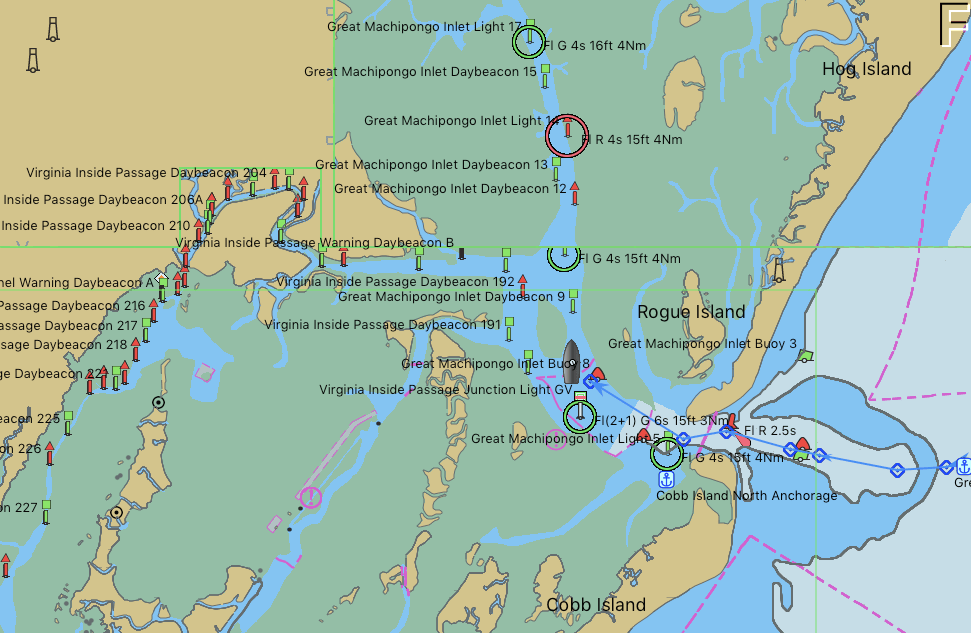
Great Machipongo Inlet

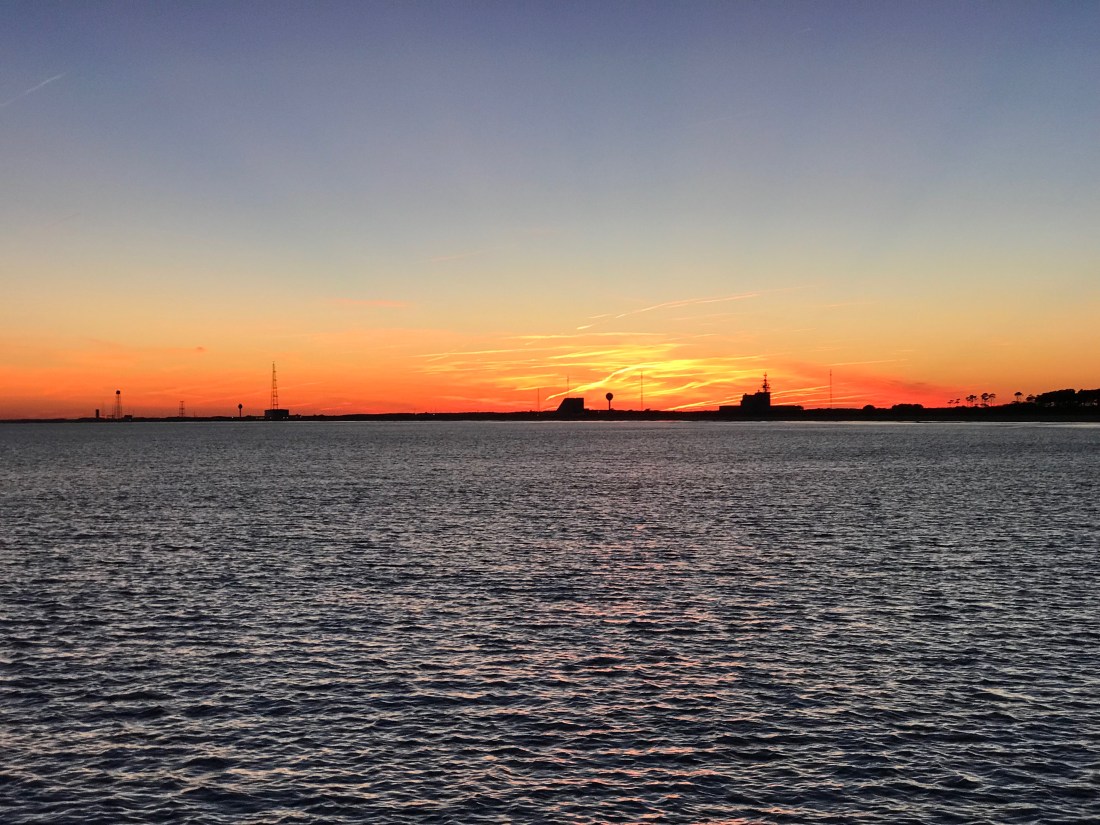
Well I read all the Internet reviews I could (only 2 of them) to gain some kind of local knowledge before entering this inlet. One review said it was horrible and the other said it was OK. So far I have no complaints. After all look at this sunset video I took once I anchored. It’s just peaceful in here.

I’ll end with this sunset video. There is something great about finishing a journey, dropping the hook and enjoying an IPA & sunset. I think it’s what humans were supposed to do.. OK after cavemen figured out the whole boating thing.
https://youtu.be/9P-T2ckm-wEe

Chincoteague Island, VA – Where are the Ponies?

We awoke around 4AM this morning and I began pouring over the charts until I felt comfortable that we could safely make the passage down the outside passage to Norfolk, VA in 4 separate legs. By staying outside we will save days if not a week of traveling inside through the Chesapeake. While we would like nothing more than to spend months exploring all the great places in Chesapeake Bay, right now we could go for some Key West sunshine.

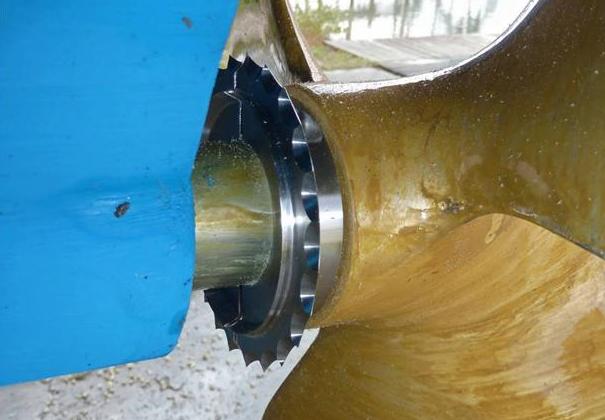
The other day we left Atlantic City and motored past the mouth of Delaware bay, I just could not bear to make a starboard turn and head up the Delaware Bay. This would mean heading North rather that South. In order to take the inside passage you must first run North up the Delaware Bay till you get to the C&D canal that connects the head of Delaware bay with the head of Chesapeake Bay. Once in Chesapeake Bay you again start heading South. It’s quite a bit longer than simply staying outside in the Atlantic Ocean.  It’s also more work for the captain, who must stay vigilant to avoid other boat traffic as well as steer around lobster pots. Nobody likes getting a lobster pot line wrapped around their propeller. We installed a “shark” pot cutter in front of our propeller to hopefully chop any lines that tangle in our propeller.

shaft shark
“Shark” Pot Cutter in Front of Propeller (Similar to MV Simple Life’s Setup)
Inside Passage Map
Inside Passage – Up Delaware Bay, Through C&D Canal and down Chesapeake Bay
4 legs map
Outside Passage – 4 Legs, 2 Anchorages

The more we studied the few inlets along the outside passage, the more we realized that many of them were possibly full of shoals and shallows to be worth trying to enter. There were some that if we did enter the inlet, it was clear that once inside it we could easily run aground due to the shallows that abounded. It was also very evident to us that our 2012 electronic charts no longer match the current depths and shoal locations. I use the charts as a “guide” but keep a close eye out for breaking waves where a new shoal may have formed due to recent storm activity.

We arrived at Chincoteague Island sometime around 1PM. The journey here was pretty uneventful. We saw only one other boat and it was a large sport fishing yacht moving at twice our speed South down the coast.  We studied the charts and found a nice spot to drop hook, close to the shore. MV Simple life has a 90 lb. Rocna, plow style anchor and 300′ of 3/8″ chain. I let out almost 120′ which was a ridiculous amount of scope (“anchor scope” is a ratio like 7 to 1: length of chain compared to depth of water). If we were in a crowded anchorage we’d never be able to let out that much scope as when the wind changed direction we’d swing into other boats. Along this coast there is not another boat in sight. After the anchor hooked up I applied some throttle in reverse (+200 above idle, or 800 RPM) which combined with the strong wind, buried the anchor. The extra throttle  lifted the chain straight out of the water with no bounce. We believe you should always “back down” on your anchor and watch to see if the chain jumps up/down which is a clear indication that the anchor is dragging along the bottom. This can happen for many reasons but some possible causes can be the seabed could have eel grass that stops the anchor from “digging in” or the bottom might not be sandy but instead a super soft silt that is like pushing a potato chip through whip cream instead of thick cheese. Better to have your anchor drag while you’re backing down on it than when the wind picks up in the middle of the night and you are fast asleep.

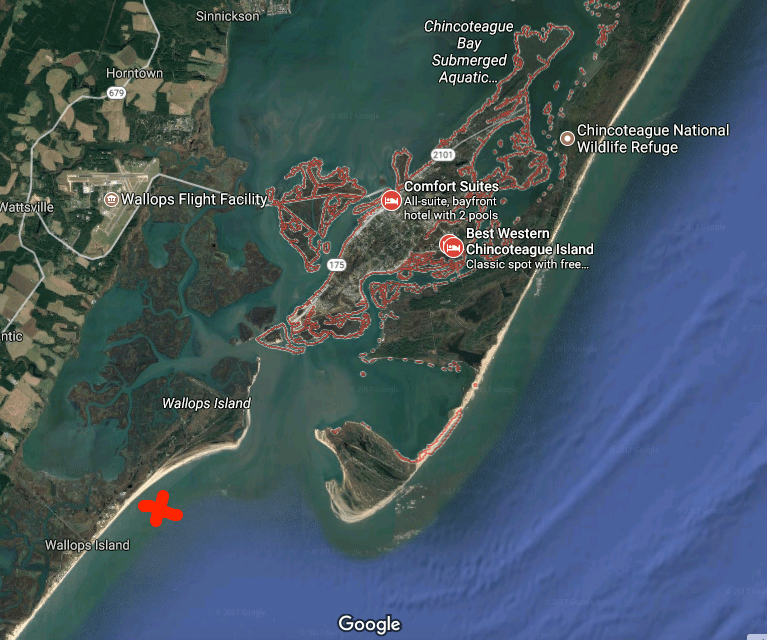
Chinoteague map
Red X is Where we Anchored – Off Wallops Island. Chincoteague outlined in Red

After reading about the wild ponies on Chincoteague Island, I made up my mind to use the crane and drop the dinghy in the water to go find them ponies. I had no sooner raced off on the dinghy before I thought.. I’m freezing & I’m zipping along over the shallow shore and could easily run aground at full speed and wind up taking a dip in the cold Atlantic. So I put a lifejacket on and turned around and made it back to the Simple Life. DAMN, NO PONIES!!!

Back at the boat the heater was on and I quickly put the dinghy back on the flybridge and warmed up to an IPA 😉 That brings me to where I am now.. sitting in the pilothouse enjoying a beer or two. We’ll leave you with our sunset view — good night.

Wallop Island Sunset