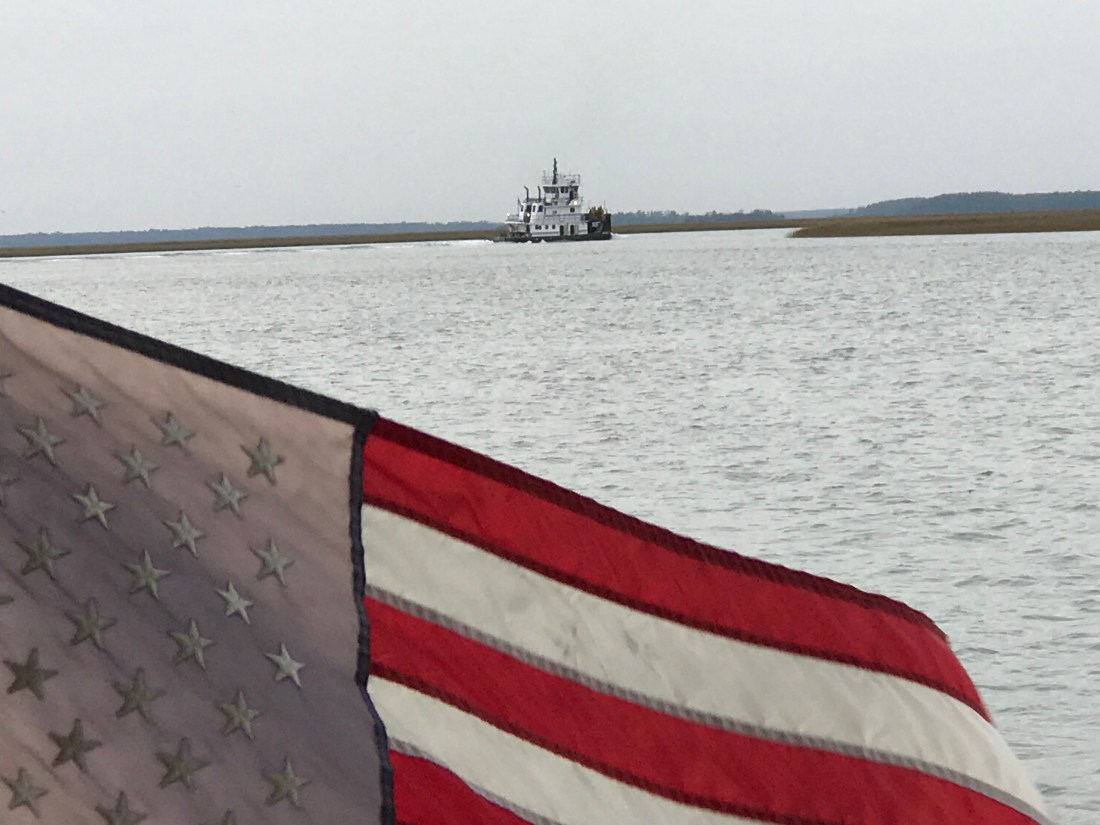
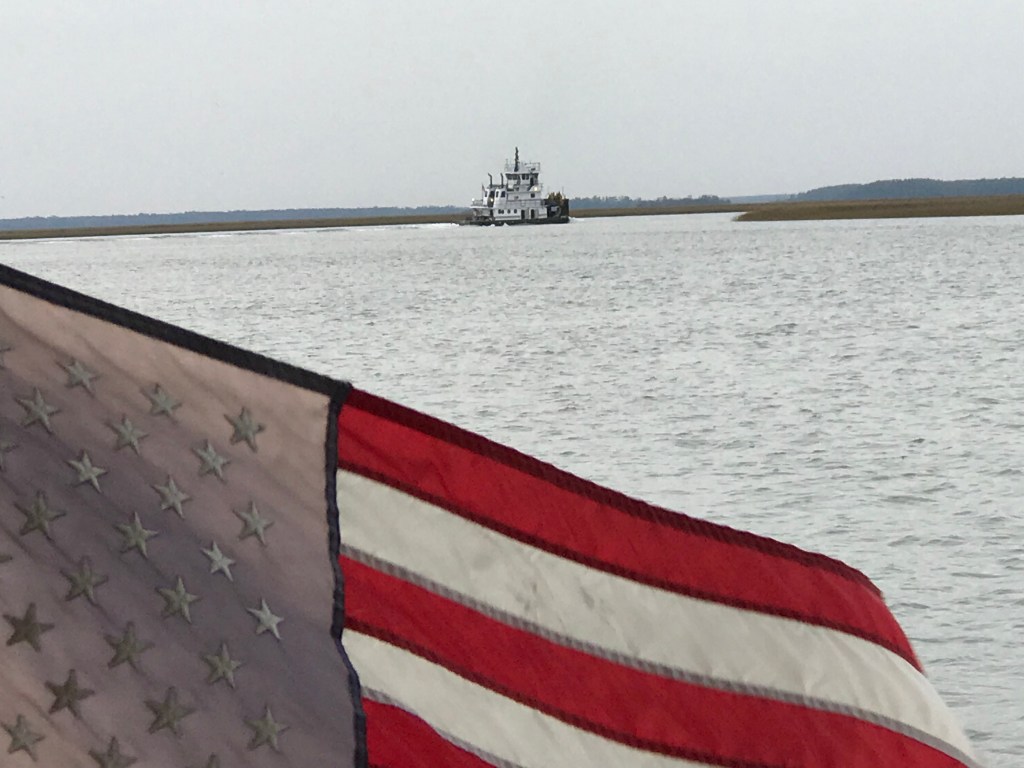
We weighed anchor in the AM and headed out of Toogoodo Creek. We followed the sinuous path that was spotted with shoals. During a VHF communication with a passing boat, the captain warned of shoals of only three feet ahead. We quipped back that MV Simple Life has a 4’10” draft (actually 4’8″ dry but after filling the tanks she sits a bit lower in the water) and that out to make things interesting. There were times when we were down to 3 kts as we hunted for deeper water but we made it to the Coosaw River as planned. What I had not planned on were the 25 knot wind whipped waves. Making matters worse, the current was flowing against the waves making them steep and breaking. Happy, our Boston Terrier, was not “happy”. She hates a lumpy ride. I had not bothered to check the weather in the AM. I was proceeding with the belief that while we were on the ICW, I could simply check the weather periodically. Even though I was aware of the Small Craft Advisory, I figured we’d never feel the full force of it while running “inside”. I was wrong. The Coosaw River runs West directly into where the 25 knot winds were coming from. We were forced to slog our way 8 miles in about an hour as the windshield wipers washed away the spray off the pilothouse windows. Not a bad ride thanks to the pilothouse.
Once we turned to port into the Beaufort River the tree-lined banks offered us some wind protection. Though even in the Beaufort River, the flags on the banks were out-straight.
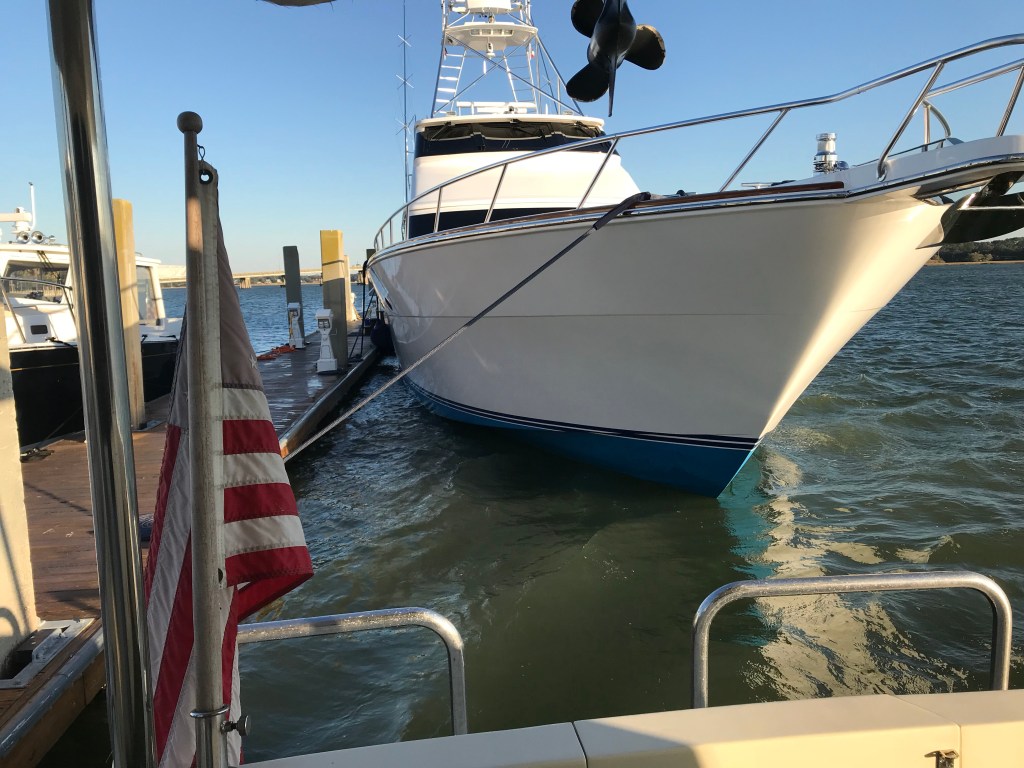
When we hailed Downtown Marina in Beaufort, SC. Dockhand Troy gave us our slip assignment and caught lines as we neared the dock. We slipped just in front of the beautiful sport-fishing boat pictured below.
Without hesitation we hopped off the boat and ran for some refreshments. We found Luther’s to be an amusing bar where the locals were.
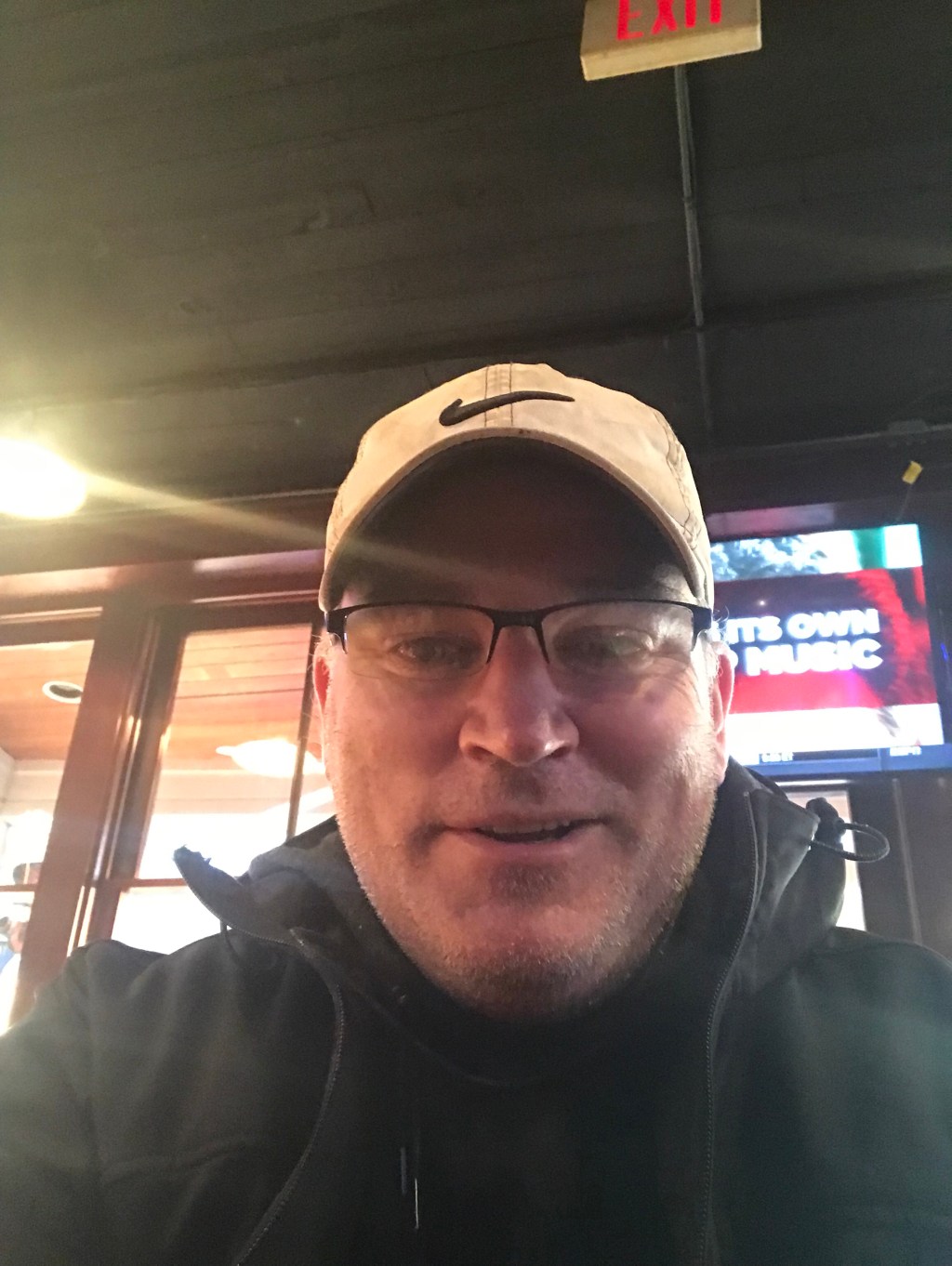
First IPA of the day and it put the smile back on my face.
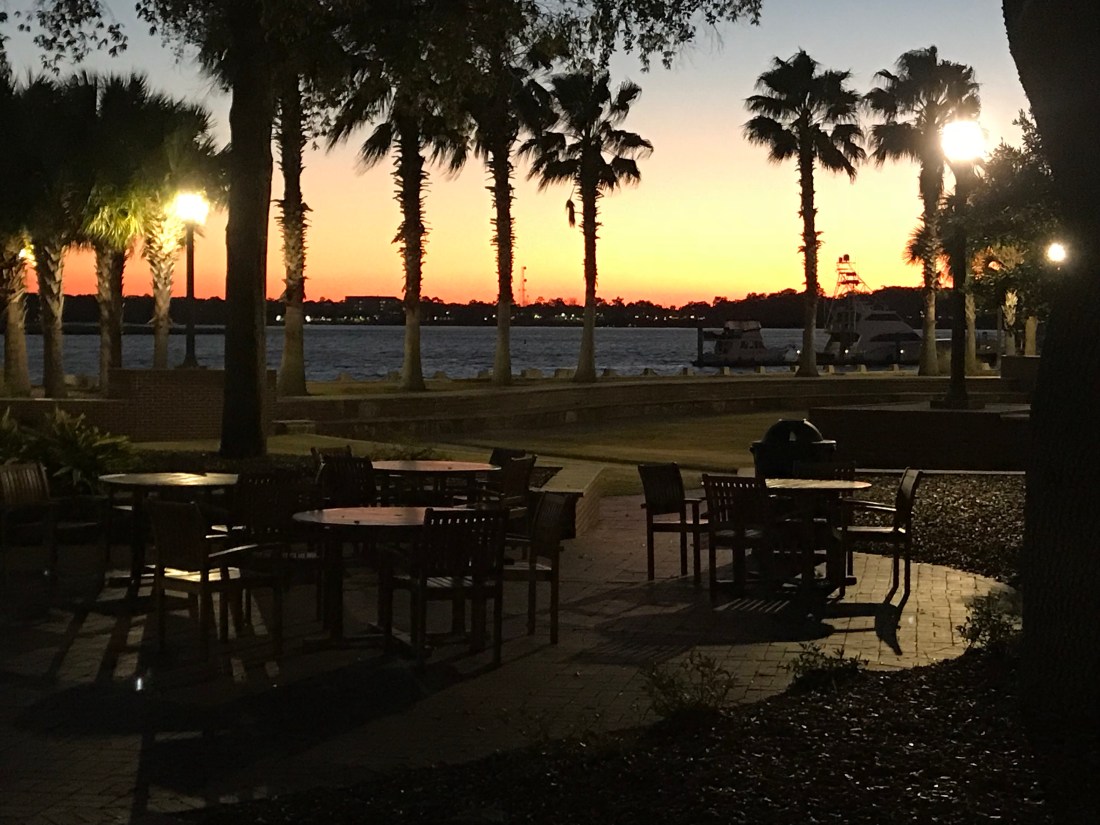
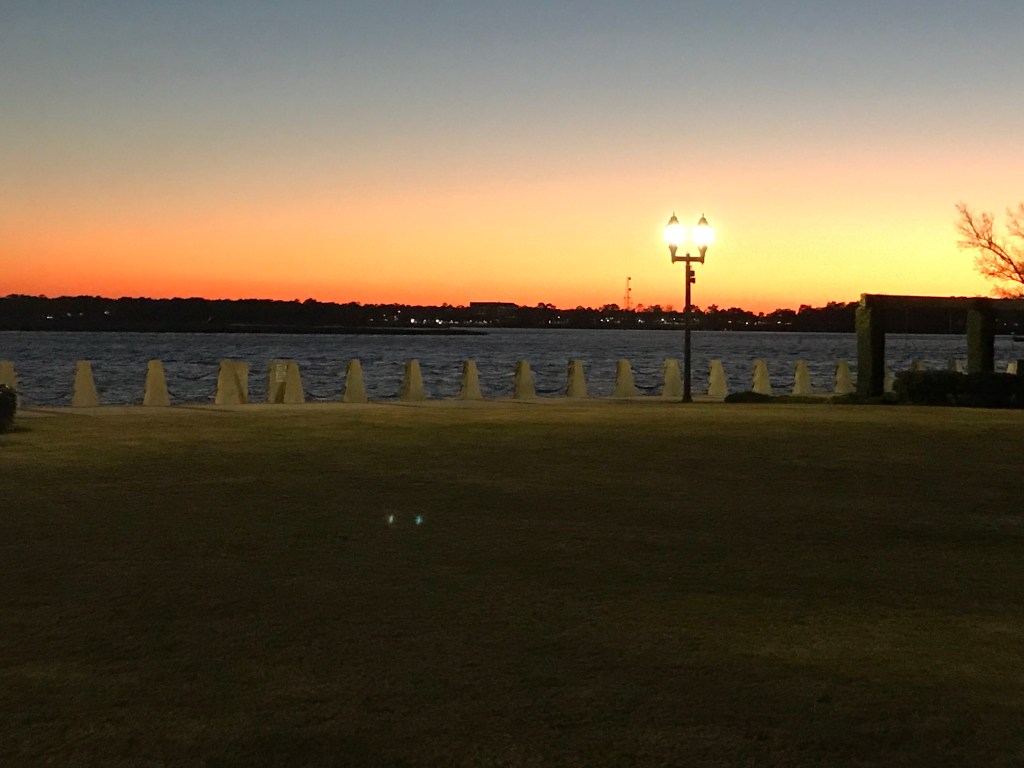
We decided to check out a few more places so we hit up a fancy place called “Saltus River Grill” and while Kelly was eying their filet mignon, the only IPA on tap was terrible so I cleverly talked her into a restaurant called “Plums” that was two buildings away and served Stone IPA. Plums had amazing food and when we could not eat another bite, it was time to stroll back to the boat and check on the dogs. On our way we walked through Henry C. Chambers Waterfront Park. I snapped the pics below as the light got low.
The next day I used the “courtesy car” to run to a local liquor store to stock up on Captain Morgan & some local IPAs
Precious cargo secured and it was time to replenish the fuel I used and get back home. For my brew-night pals, here is the list of local IPAs that I will be sampling and then reviewing using the Untappd app.
We got a lazy start and the boat that was anchored next to us (captured in the photo below taken just after anchoring) was long gone by the time we weighed anchor.
Last night’s view of the sky was amazing. The stars popped like I have never seen. It would seem that being devoid of any extraneous light makes the cosmos seem even larger and us even smaller.
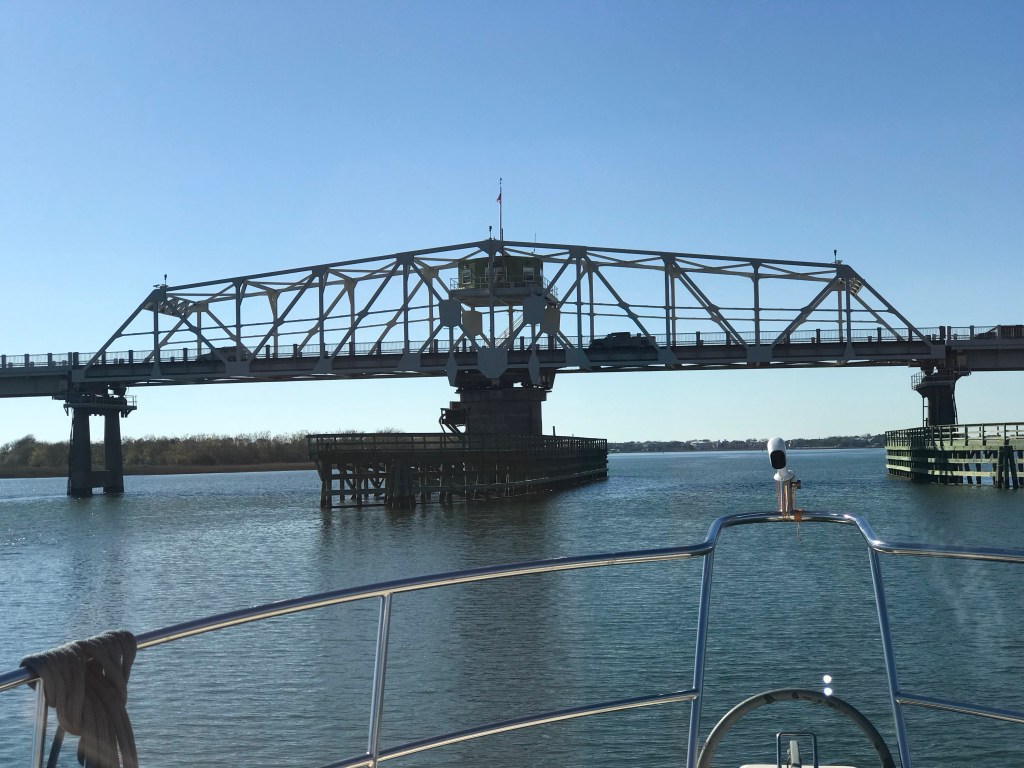
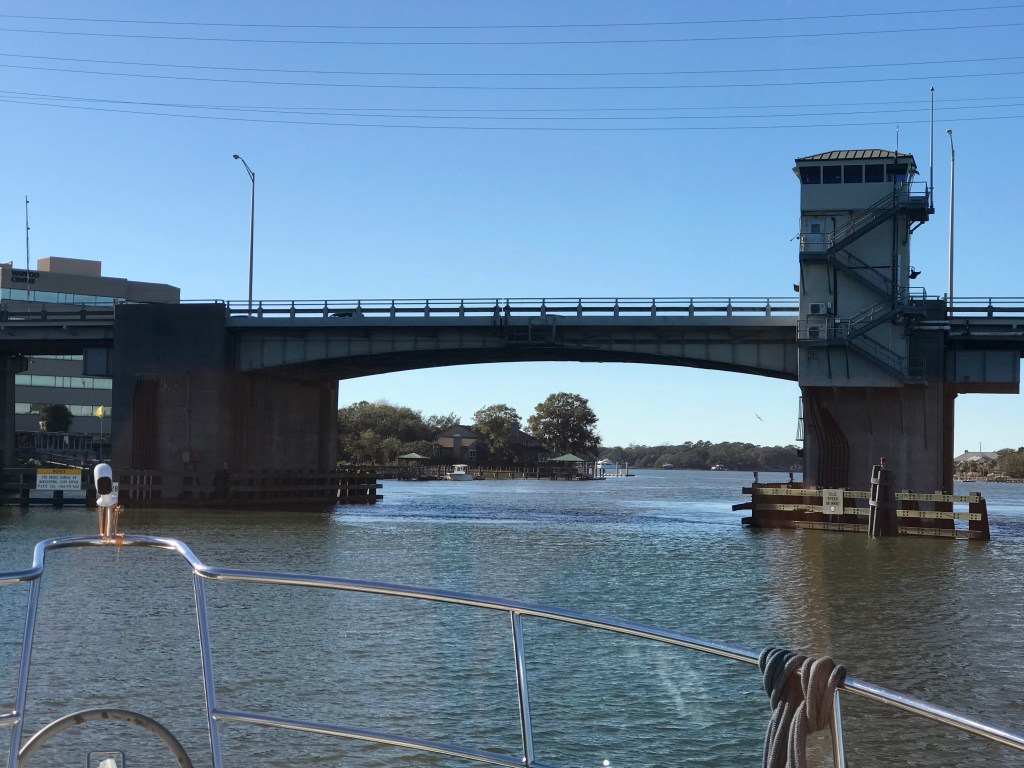
We navigated beneath several bridges.
Ben Sawyer Swing Bridge located at SM 462 along the ICW in Sullivan’s Island South Carolina.
Wappoo Bascule Bridge located at SM 470 along the ICW in South Carolina.
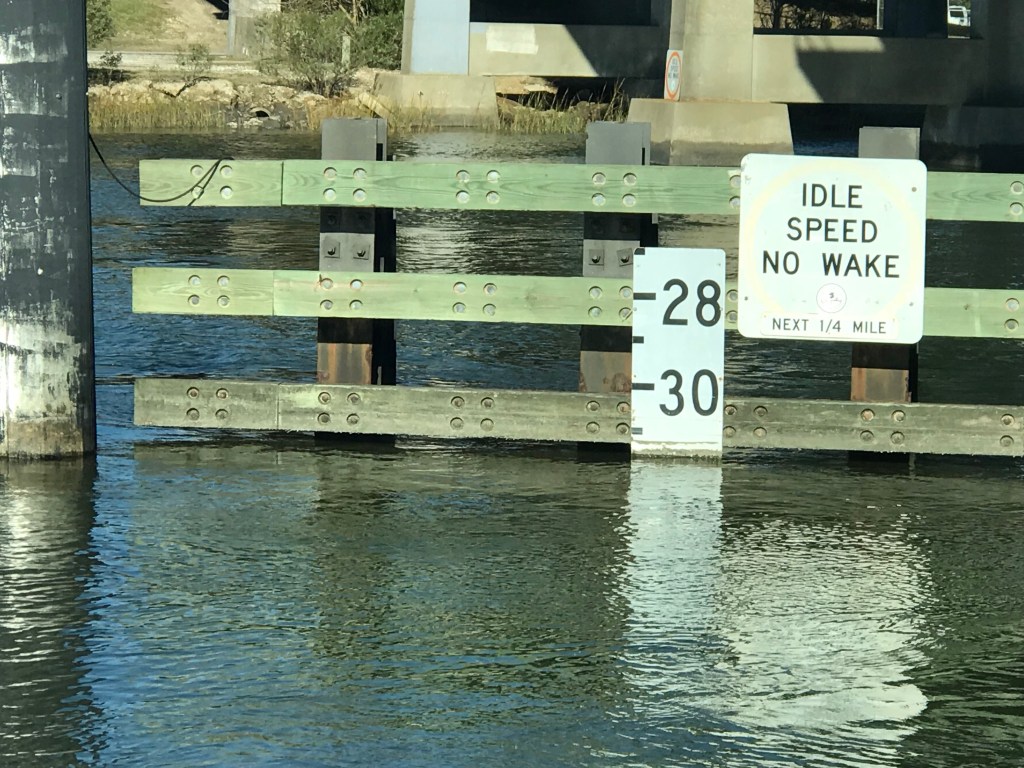
Both of these bridges had about 30′ of vertical clearance so no need to hail the bridge tender for an opening.
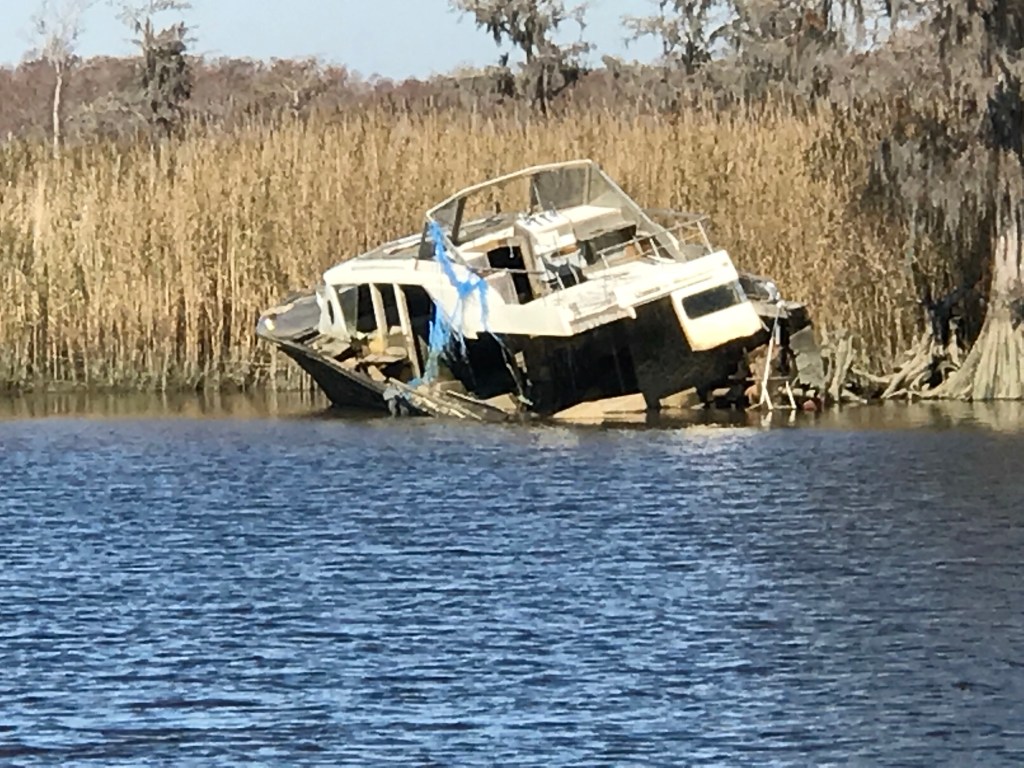
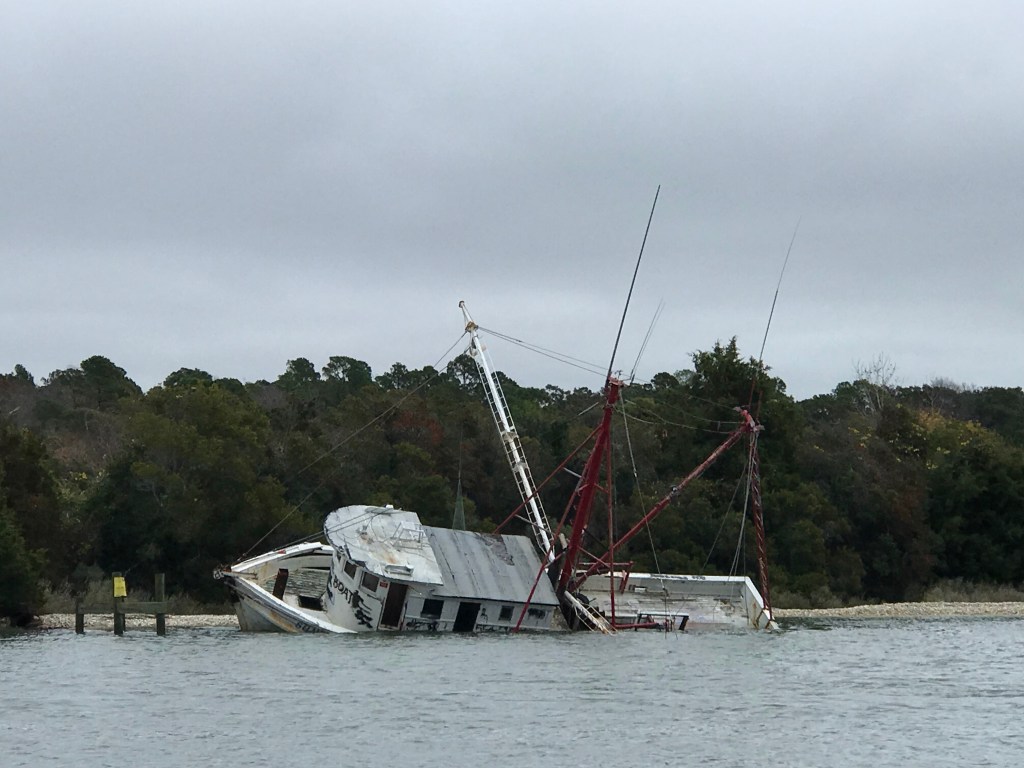
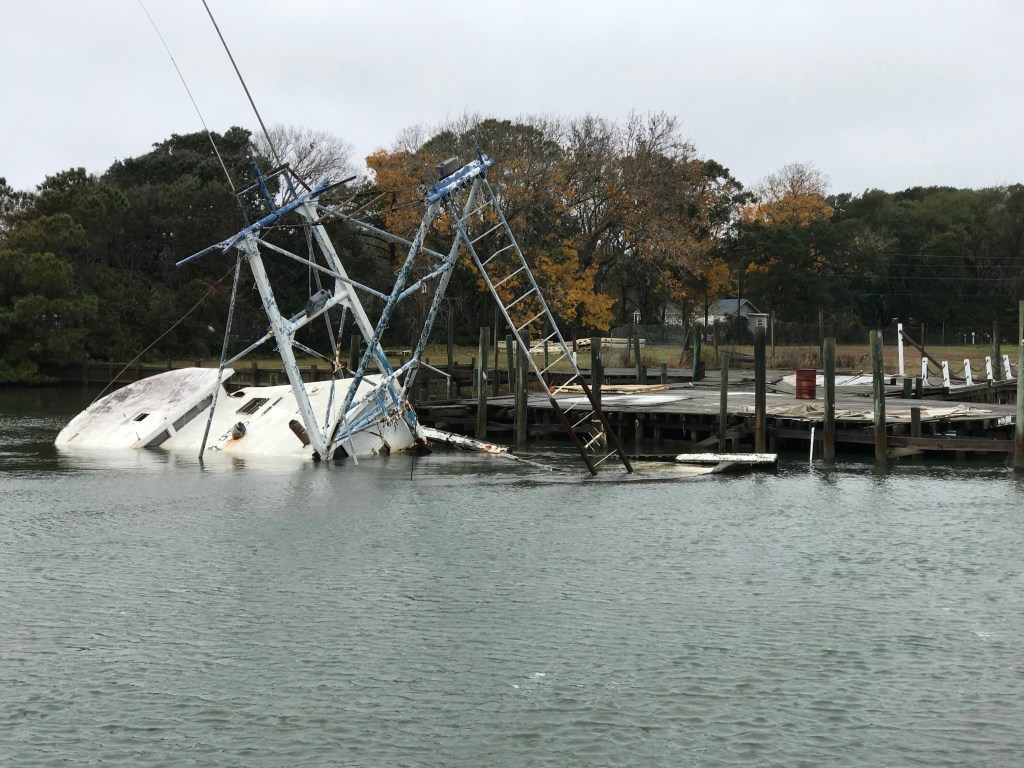
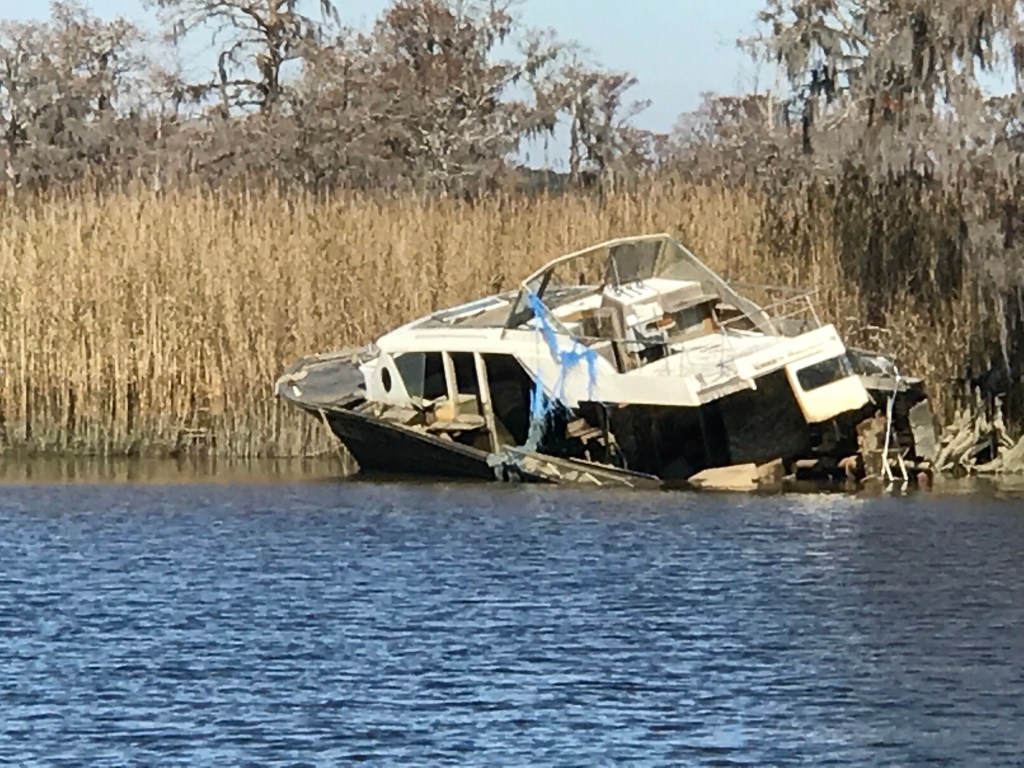
We also passed several ADVs (Abandoned or Derelict Vessels) along the way.
NOAA has a website dedicated to helping with ADVs.
Abandoned boats are a problem everywhere. When she is new everyone flocks to see her. When she falls into disrepair, her value can be upside down. The cost to junk an old boat or the salvage fee after an accident or storm only adds to the abandonment problem.
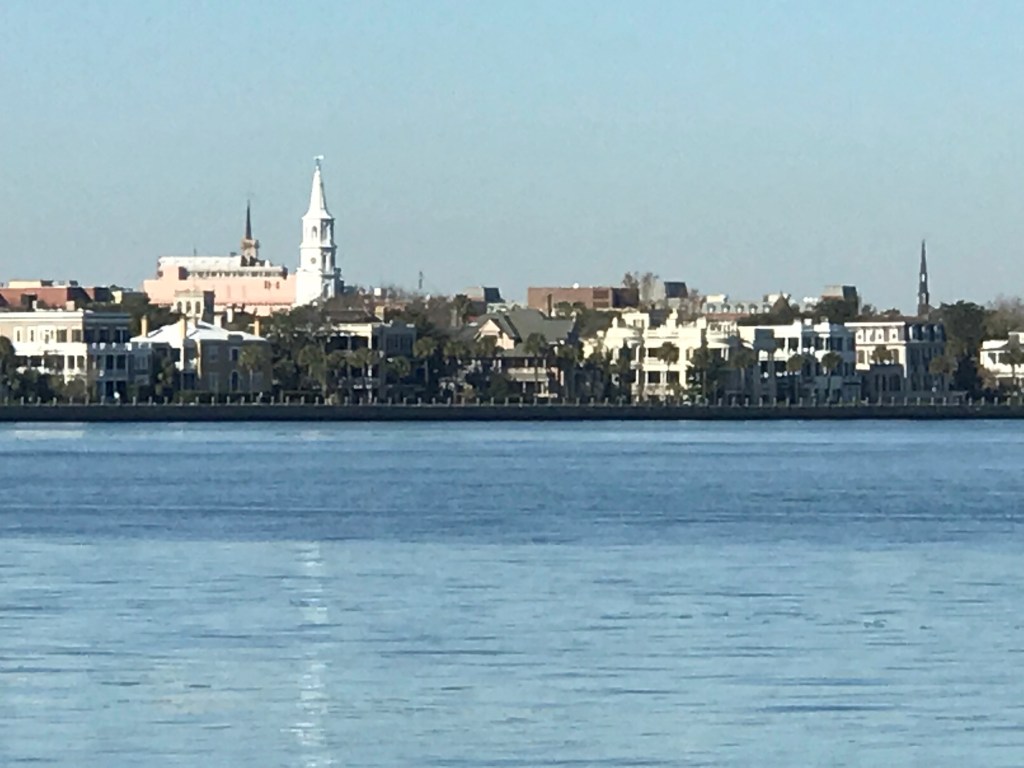
As we sailed into Charlestown, SC, you could see the tall steeple of what I think might be St. Philip’s Church built in 1836.
While the thought of exploring Charleston was buzzing in our heads, we remarked that we could stop on the return trip. There are so many great stops along the ICW but if we stopped at all of them we’ll never make it to Florida.
The moss on the trees reminds you that this is South Carolina and not Rhode Island.
The type of tree that surround this home are everywhere along the shore. Maybe a type of oak tree?
I’m dying to see one of those live oaks that look like something out of a fairytale down here.
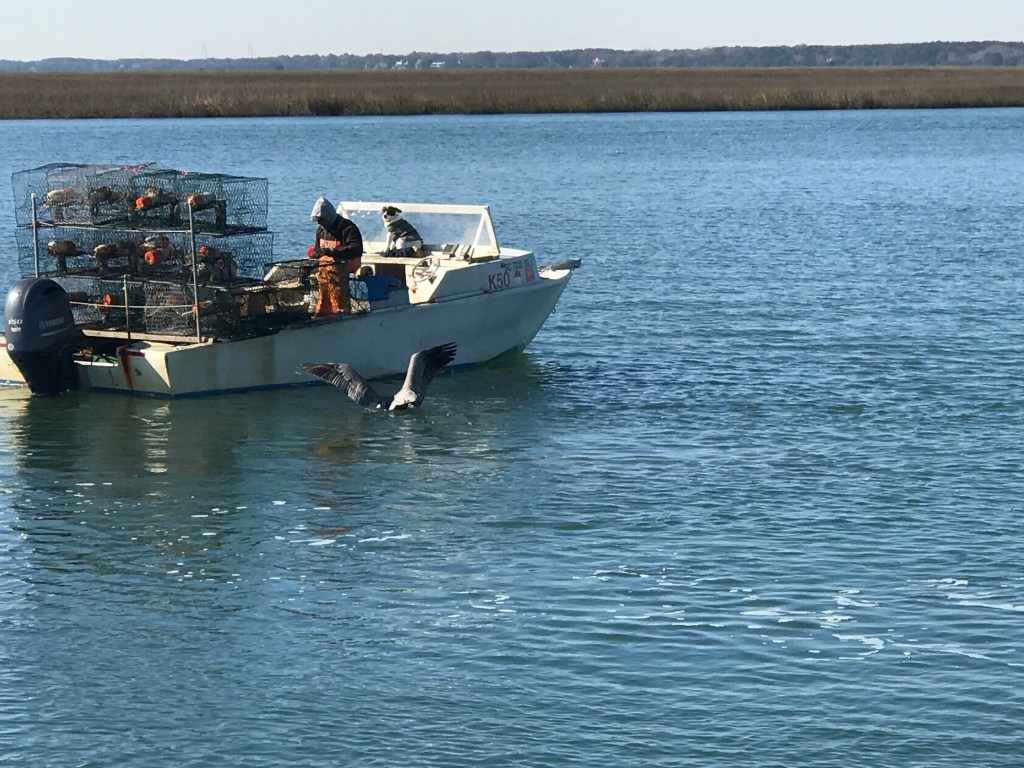
We passed many crab boats that would race between the crab pot floats that line the channel. You can always tell the boat up ahead is a crab boat because the birds follow them wherever they go. As the pot is pulled to the surface, the crabs are measured and those to small are discarded back into the sea. The flock of sea birds use this opportunity to nab an easy lunch.
Don’t you just love that man’s best friend is tucked up behind the windshield absorbing whatever warmth from the sun could be found?
Kelly & I got a kick out of seeing this “flats boat” with a man on the back pushing it through the shallows with a push pole. I could only imagine how difficult it must be to balance on that small platform as the boat rocks. We slowed as we passed so our wake would not flick him into the cold water.
As the sun got low in the sky it became clear that I needed to pick which anchorage I was going to drop the hook in tonight. Kelly requests that I research anchorages ahead of time that have strong Verizon cellular signal strength so she can watch the football games using the NFL Mobile app on her iPhone. While cruising we consume cellular data like teenagers stranded at the adult party.
We anchored in a creek called Toogoodoo just in time to watch the Patriots game.
We awoke this morning at sunrise and the Waccamaw River was still.
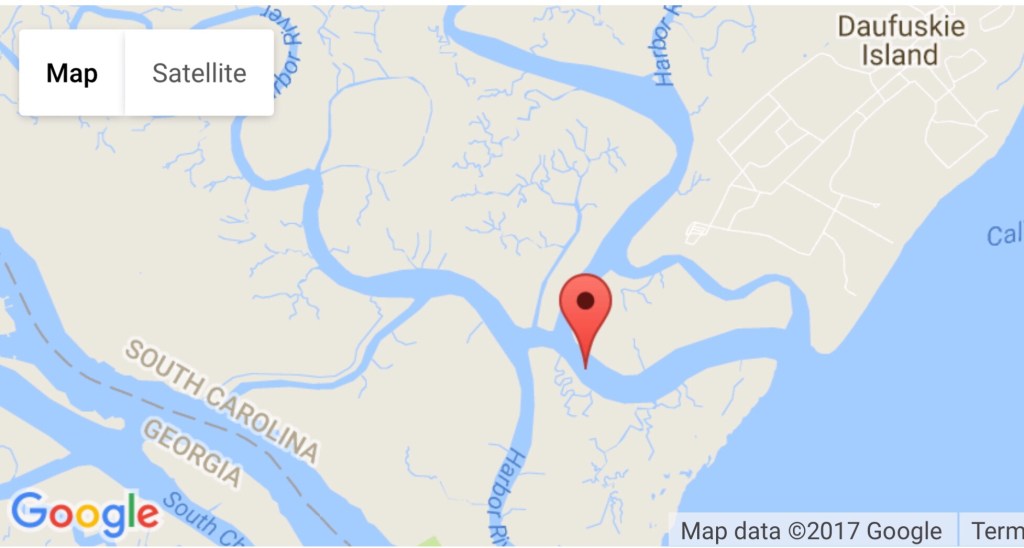
Only after looking at Google Maps did I become aware that the creek that we anchored in was really the Waccamaw National Wildlife Refuge in South Carolina.
Along the route to Georgetown, SC there were many hazards dotting the ICW.
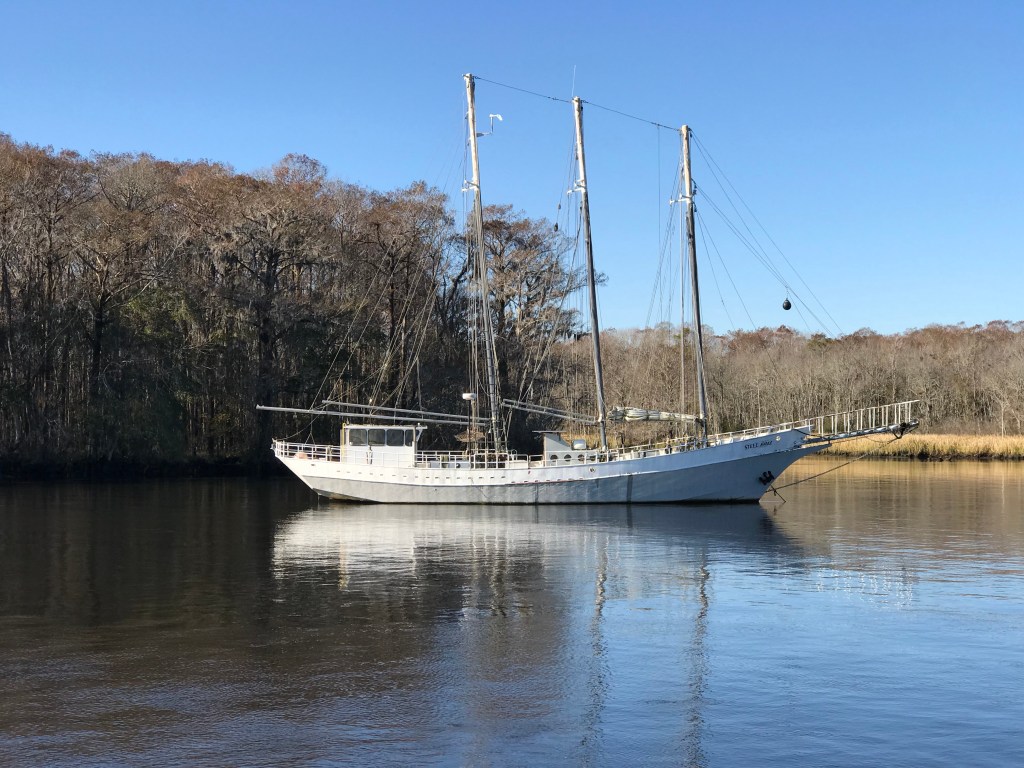
We did not see many other boats as we traveled along. We did see this steel hulled schooner called SV Steel Away. Nice vessel for the ocean and anchoring in.
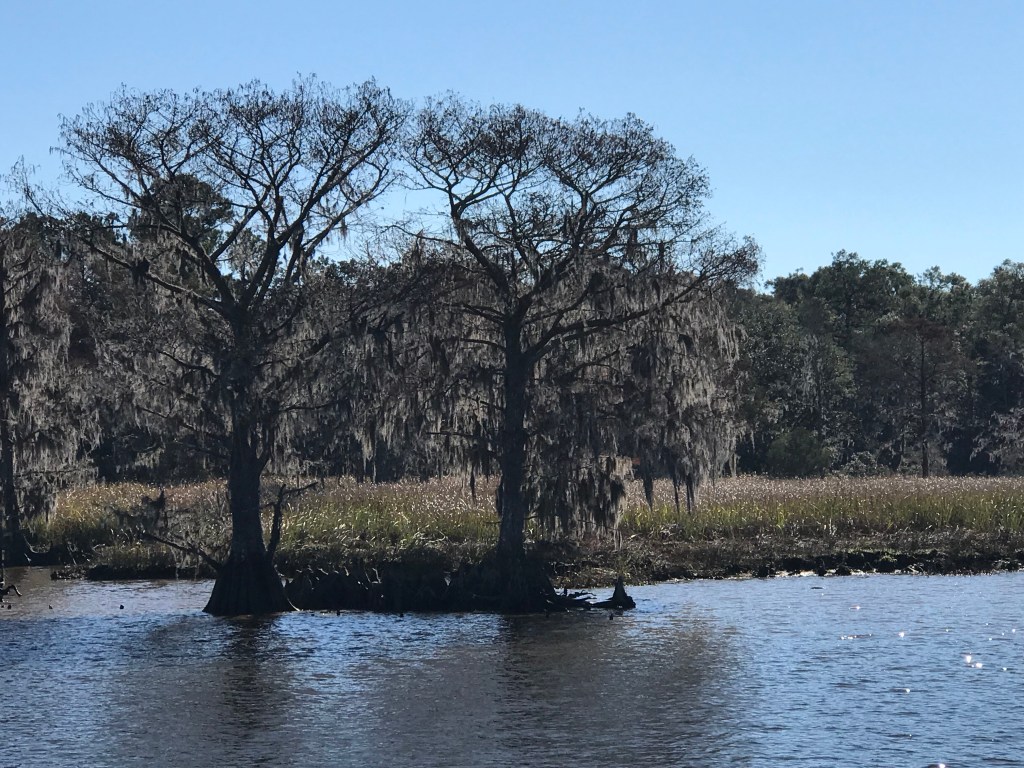
We saw mossy trees.
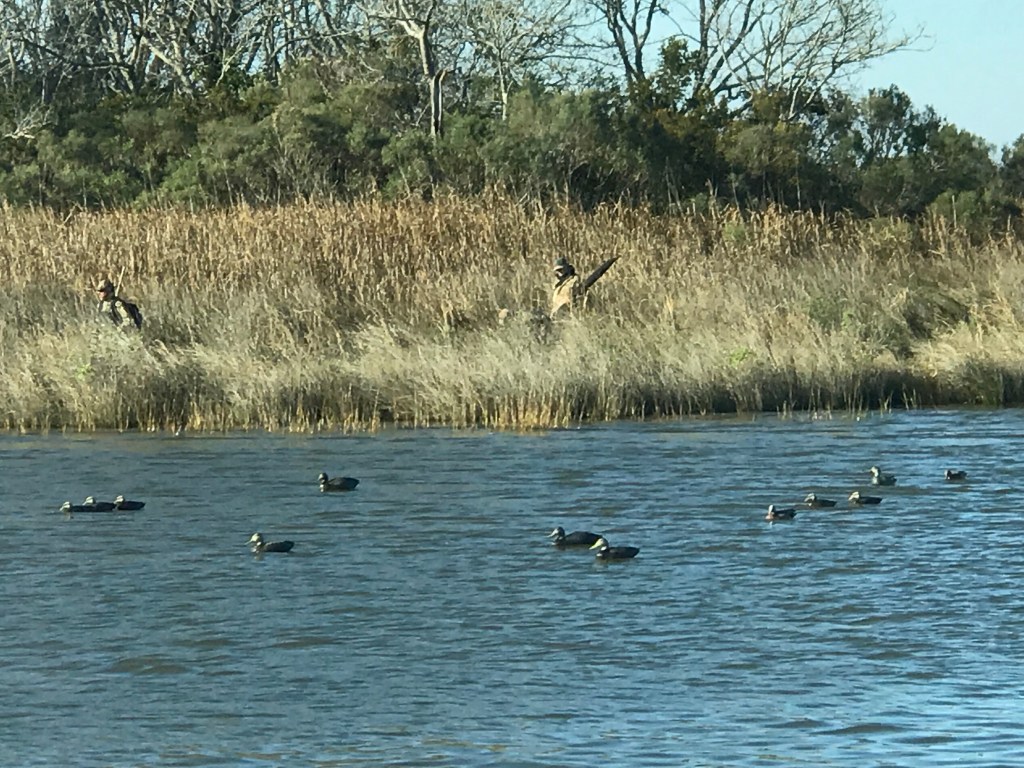
As well as duck hunters in the mashes that lined the ICW.
When we arrived in Georgetown, the air was scented with the smell of a paper manufacturing plant. We made the decisions to continue on.
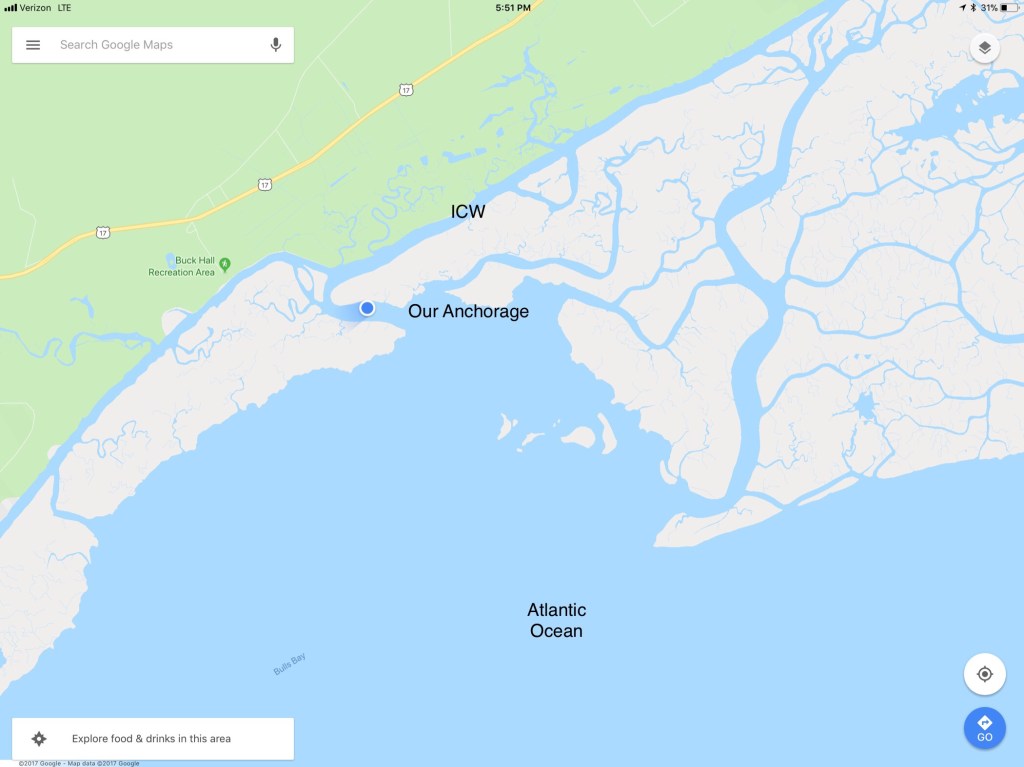
As the sun began to set we were forced to find an anchorage and we picked this one on the Atlantic Ocean just a 1/2 mile off the ICW.
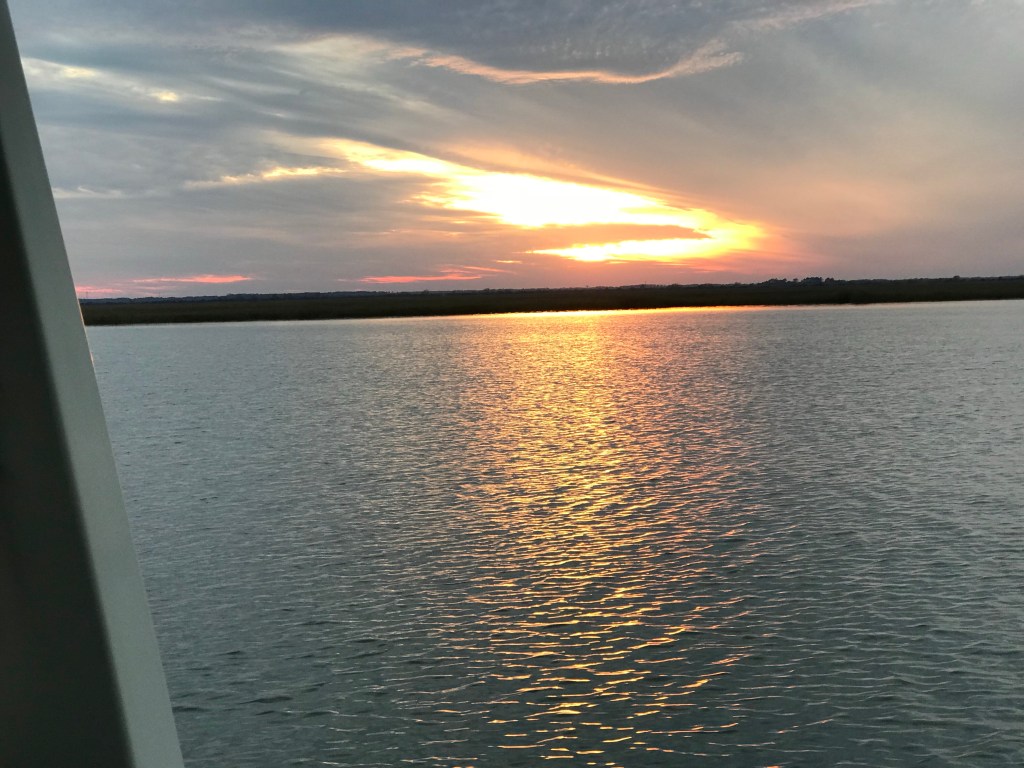
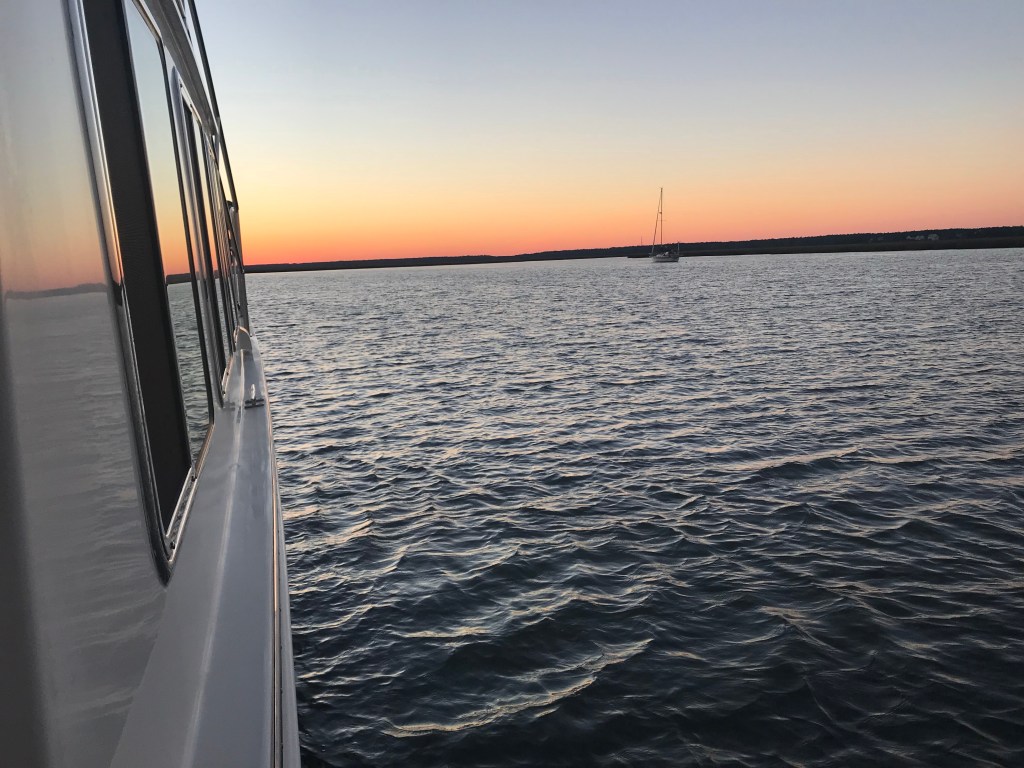
We dropped the hook just as the sun was setting and it was beautiful.
There was one other boat anchored with us which was about the only other boat we saw. This sailboat was from South Carolina so we are not even sure if they are snowbirds like us?
The last thing to do after a full day at the helm was to cook up some steaks on the griddle and sit back and relax.
We got a late start leaving St. James Plantation Marina in North Carolina. I think we were enjoying ourselves and were just slow getting moving in the AM. Kelly eventually woke and made an amazing breakfast on the griddle and I filled the water tanks, emptied the trash and pulled the boat over the pump-out and we were off.
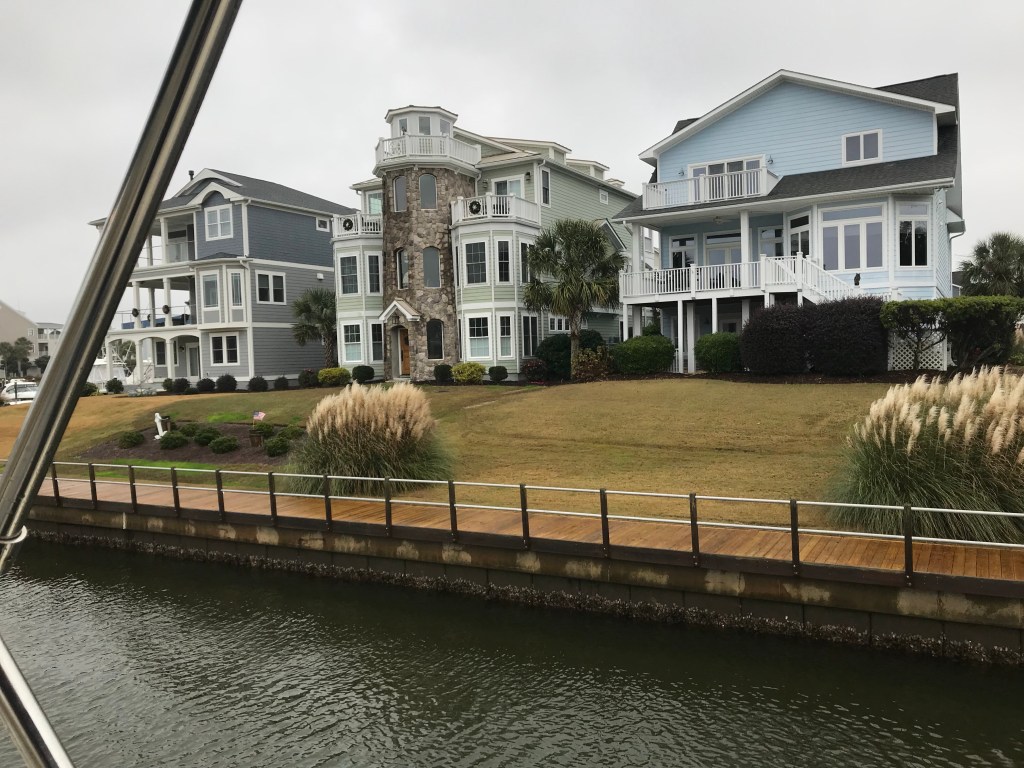
Pulling out of the marina we were reminded how beautiful the houses are and what a great place this is.
As we exited into the ICW and headed South, we were reminded that this area has strong currents and tricky shoals that form around both Lockwood Folly Inlet and Shallotte’s Inlet. To offset the danger of running aground on a shoal we spent the wee hours downloading the US ACE (Army Corp of Engineering) navigation hydrologic maps of the inlets. What a great job the ACE does surveying these tricky inlets and making the sounding maps available for FREE to snowbirds like us. Thank you.
Current rip in the inlets. Each Division / District has its own website so you’ll have to spend some time finding the hydrologic maps from each ACE District. That’s a narrow drugged channel that you must stay inside of Stay to Port.
As we headed South we saw many beautiful sights.
We have no idea what species of bird this is but we are committed to learning more about the aquatic bird species that inhabit the ICW.
This lighthouse was somewhere around Myrtle Beach. It’s though to see but there were Christmas lights strung off the walkway around the light.
An Atlantic Ocean inlet. Maybe this was around Lockwood Folly Inlet?
We find the breaking waves beautiful. What a great beach for walking the dog or just contemplating life.I think the sign said something like Greg Norman’s Australian grilleWe love that this guy was taking his dog for a ride. Man’s best friend loves the boat says Happy & Chief Martin Brody. “Born 200 years too late” – Jimmy BuffettSomewhere Myrtle BeachClose Encounters or an airport building, you decide.Who wants to walk under this rack with high winds and a 10K lb boat resting 80′ over your head?
There are many dangers along the ICW..
Slow down and read the signs of life… they point toward safetyLogs are the bumps in road of life They thud your hull or fold your wheel (that’s a propeller for the un-initiated)We hate to see beautiful commercial fishing boats listing on the bottom. We joke that we’d love to pull her up drain her beige, gut her and rebuild her giving her a sexy teak makeover. Kelly reminds me that the stink of a fishing boat is not washed off with soap. Ouch!
Heart breaking.
Well, we anchored in a narrow creek tonight. It’s inky black and a bit windy but we buried the 90 pound and 3/8 chain anchor deep by backing down on it. We were forced to only let out a short scope of rode. Any more and when the tide reverses we’ll swing into the banks of this narrow creek. So we’ll call it a night and make our way to Georgetown, SC in the AM.
We are leaving St. James Plantation Marina in Southport, NC this morning but made a promise to come back and spend more time with our friends Jim & Wende. They were very gracious hosts while we were here and we got to share in the experience of being in a “private town”. So very interesting though I must say Kelly & I will have to investigate exactly what that means?
Thanks Jim & Wende, you showed us a great night off the boat and we promise to come back and spend more time.
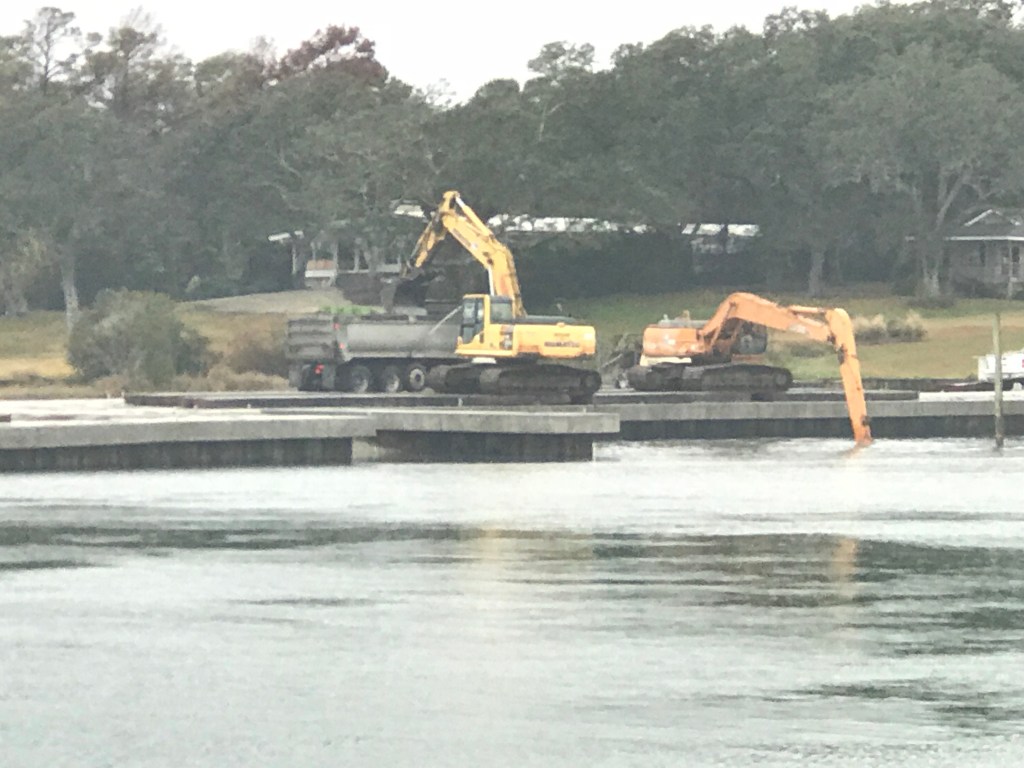
The night before we had anchored in Sloop Point, NC and the trip down to Southport was an interesting one. We saw heavy equipment dredging around what looked like a new pier going in. I know what salt water does to steel and I still shudder at the thought of dipping an excavator’s arm into salty water. I’m sure the water in the ICW is brackish but still.
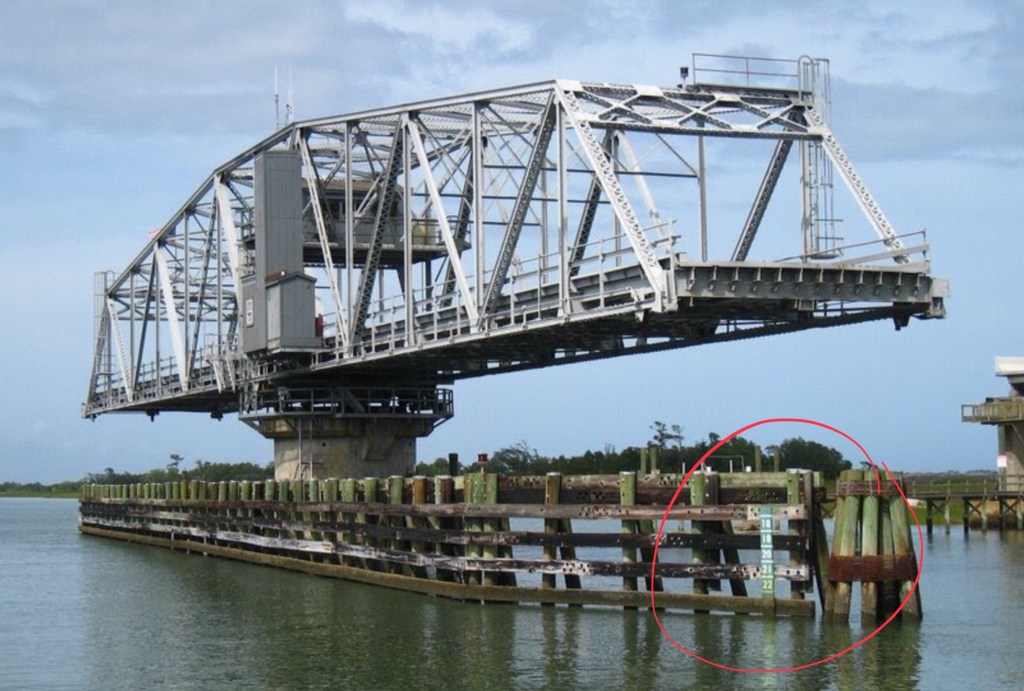
I was checking my ICW bridge list and realized that I would not make the Figure Eight Swing Bridge in time for their restricted opening time. This meant that I would be waiting for the next opening. However the bridge tender who I had hailed on the VHF asked me about my air-draft. Your “draft” is your vessels depth in the water and your “air-draft” is your vessel’s height above the water. I replied that I believed it was somewhere between 21-22 feet. The bridge tender remarked that he currently had 22′ of clearance. Every bridge along the ICW has a “height board” that is partially submerged under the water with height markers at the waterline. While all bridges on your nautical charts will list their height at an average high tide, the actual vertical clearance varies with the height of the water. The bridge tender offered to come out of his office and stand under the bridge to check my clearance if I wished to approach the bridge slowly. This can be a tricky maneuver as there was a current pushing Simple Life toward the bridge. I slowly edged the boat idling in reverse to the bridge and bridge tender assured me that I had a good 6″ of gap between the top of our boat and the bottom of the bridge. MV Simple Life’s air-draft is 21′ 6″.
Below is a stock photo of the Figure Eight Swing Bridge as I was too busy at the helm to snap pictures. You can see I circled the “height board” and at the time this picture was taken there was slightly less water under the bridge giving even more clearance than the 22′ we had the other day.
Just a few more miles down the ICW and we had to pass through the Wrightsville Beach Bascule Bridge located at statute mile 278 along the ICW. This is a restricted bridge that only opens on the top of the hour.
As we continued on to Cape Fear (Southport, NC) we were delighted at the scenery.
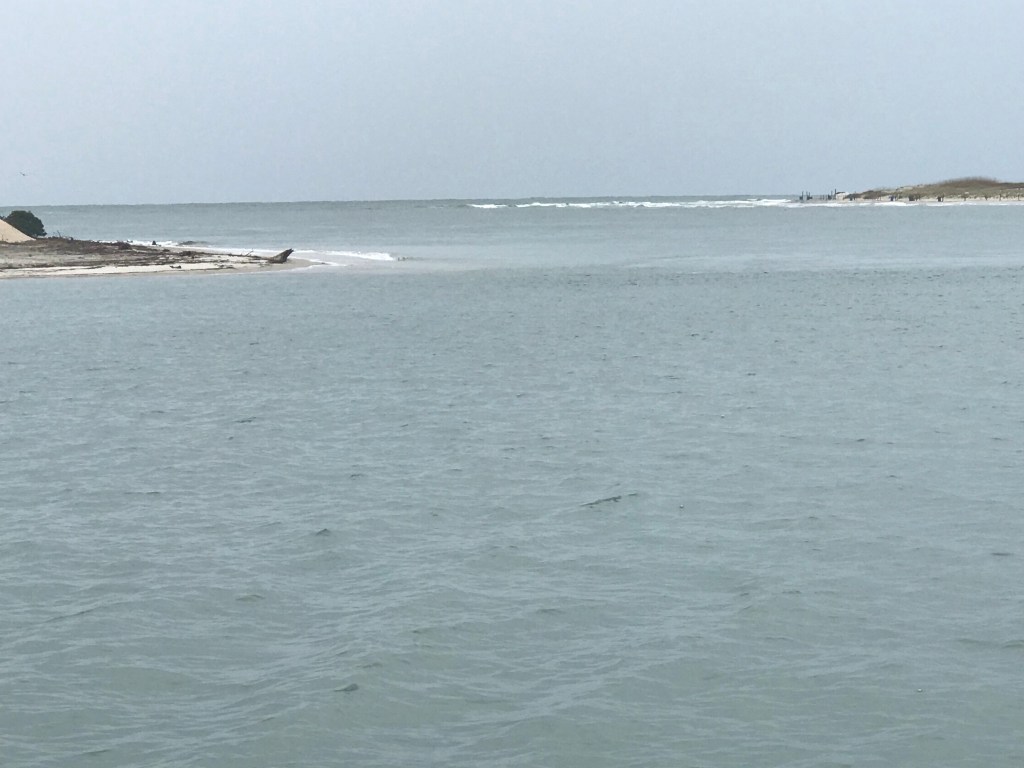
We passed many Atlantic Ocean inlets that had high sandy bluffs and marshy islands dotting the entrances. You could see and hear the surf breaking in the shallow inlets and it makes for nice scenery. The last of those 4 photos is one of a fixed dock that just barely exceeds the height of the water level. Interesting choice of fixed dock heights as this surely must be slightly submerged at times? Slightly submerged docks must be fun to walk along but just like submerged rock jetties that often protect many of the ports we enter they can be dangerous if boats come into contact with them.
As we got the point where the ICW connects with the Cape Fear River via “Snow’s Cut” we were passed by a US Army Corp of Engineers survey boat. These folks use sophisticated sonar to accurately probe the depths of these constantly changing waterways. He kindly slowed down as he passed and got back on plane once he was in front of us. However, just then the VHF crackled on channel 16, “Trawler in Snow’s Cut, are you OK?”. I quickly answered the hail with “comeback to the trawler in Snow’s Cut”. It was a boat in a marina that was hailing us stating that they “saw what had happened”. I replied, “If you are referring to the ACE boat that passed us, yes we are OK”. I found this communication amusing and I can only guess that the survey boat had passed the marina giving a large wake and making the marina boat unhappy and maybe this was her way of shaming the ACE boat publicly on the VHF?
It would seem the kids in Snow’s Cut like to party at this old bridge abutment. “Party on” Capt B.
Once in the Cape Fear River it became quickly apparent from the size of the docks that extend out into the river that this river is used by large ships. Passing these behemoths must be done at a distance.
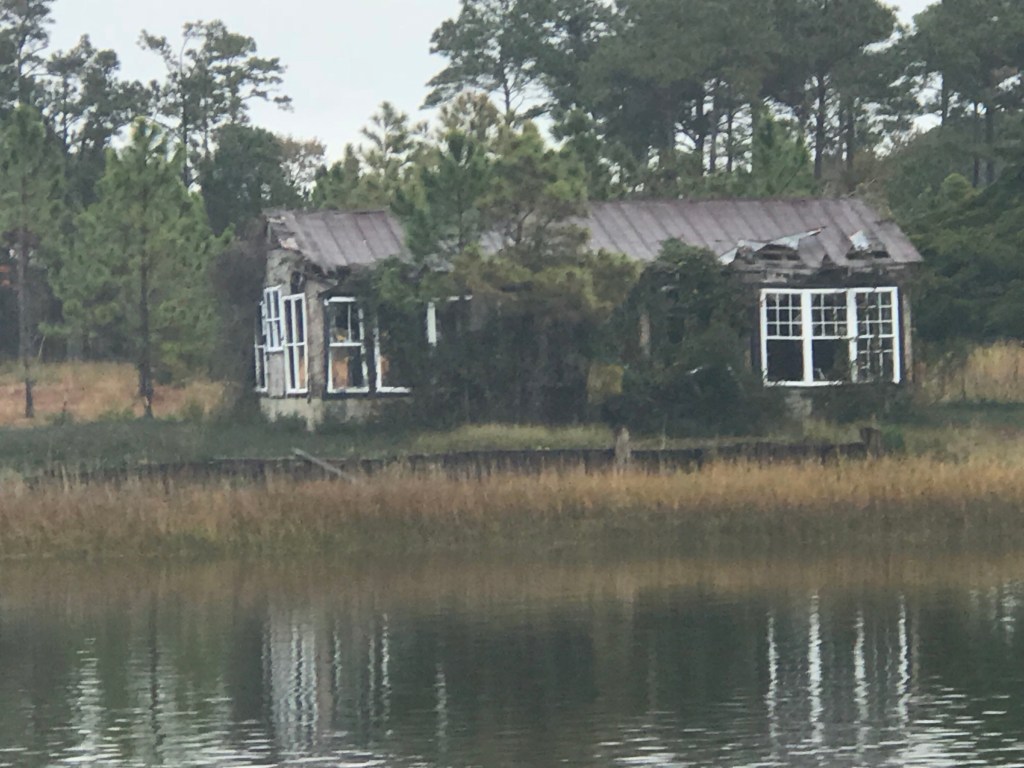
A quick turn back onto the ICW, by a dilapidated building and we arrived at St. James Marina.
Time to push on to Georgetown, SC where we’ll update with a new post of what we saw along the way.
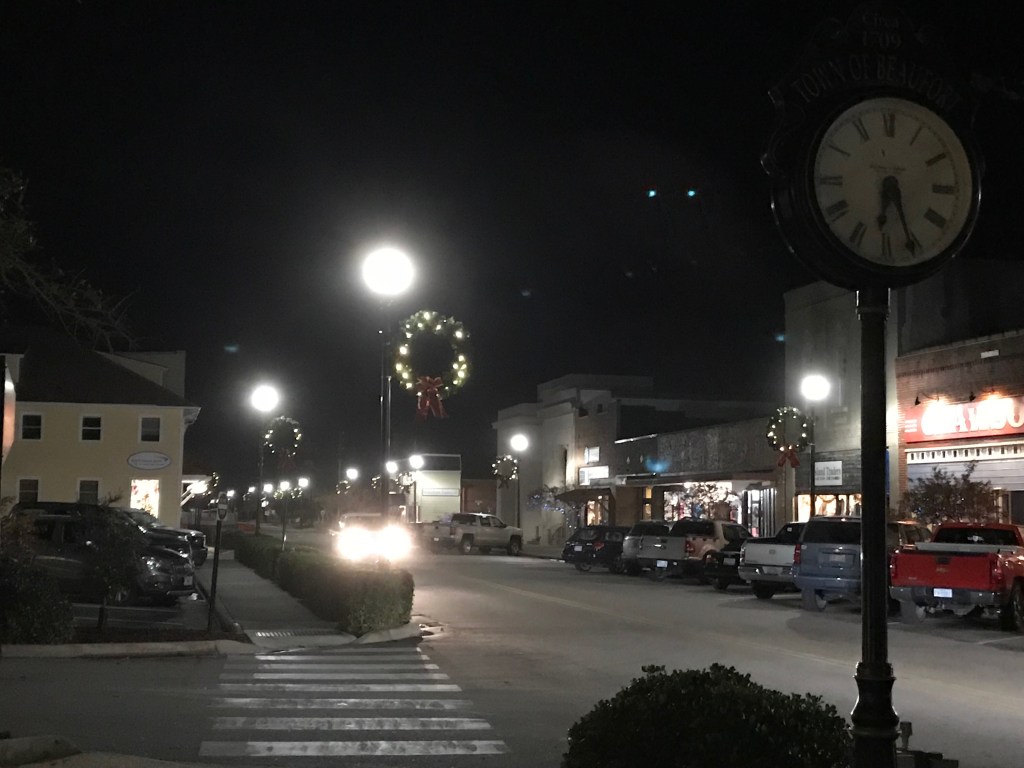
Beaufort, North Carolina is your quintessential small southern town. It is the 3rd oldest town in North Carolina and as you walk through this quaint small town, you can’t help be taken a back by it’s charm.
As we came ashore there were two monuments to local heroes within feet of where we landed. The first was Michael John Smith who gave his life for the pursuit of space exploration. Michael was a NASA space astronaut. Like so many, I believe that every human owes a great debt to astronauts who risk their lives so that the human race may have a better chance at surviving this hostile universe. They take risks that many of us might think too great. Michael was aboard the Challenger space shuttle when it exploded only 73 seconds after launch. The entire nation stood in horror at that moment, Like so many of you, I recall the shock and disbelief of this tragedy. The whole nation was forced to mourn the loss of these 7 heroes.
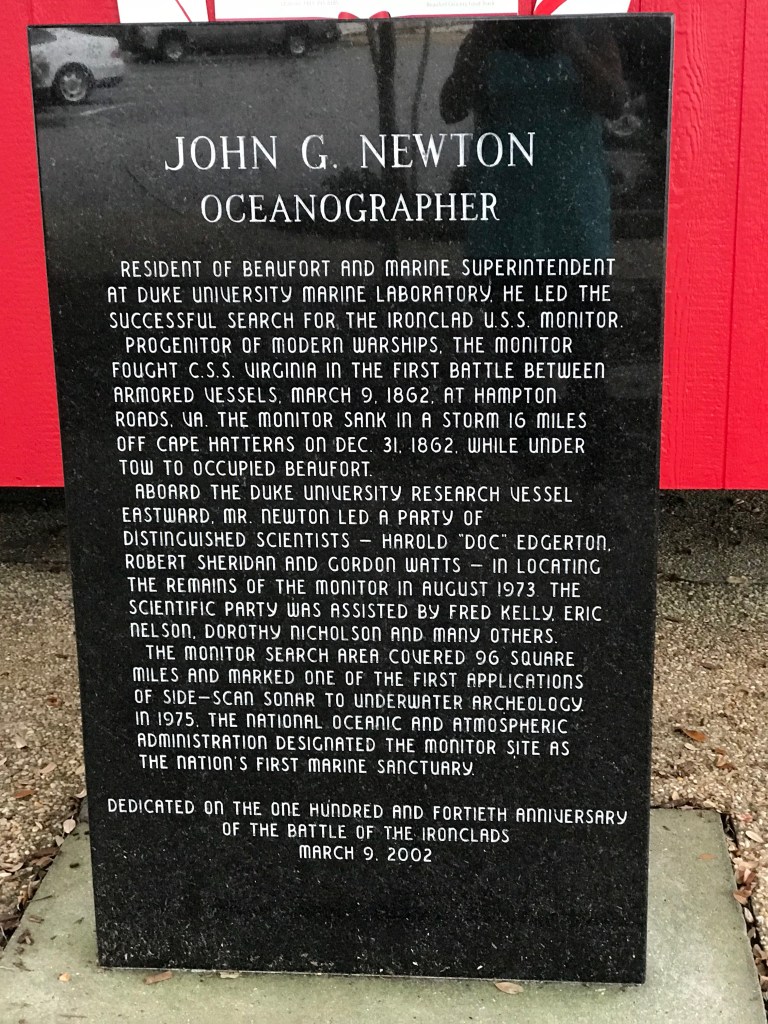
The second memorial stone was dedicated to a local oceanographer named John G Newton who discovered the U.S.S. Monitor using side scan sonar technology. Side scan sonar is an improvement on the DSM (Depth Sounder Module) that MV Simple Life uses to determine our depth as we came into Beaufort.
Leaving Beaufort was as tricky as getting in. The currents here in Beaufort are swift. When we arrived, I had to swing MV Simple Life into a narrow fairway with an extra strong 3 knot current directly on our beam. Simple Life’s full keel gives that current a flat surface to push her down-current quickly. With some fast movements at the helm and some help from the thrusters we landed her gently into our assigned slip. The trip out of the slip was made easier by the fact the strong current was on our bow. I nudged her out of the slip and simply swung the bow a few degrees off the current and she quickly pointed out of the fairway.
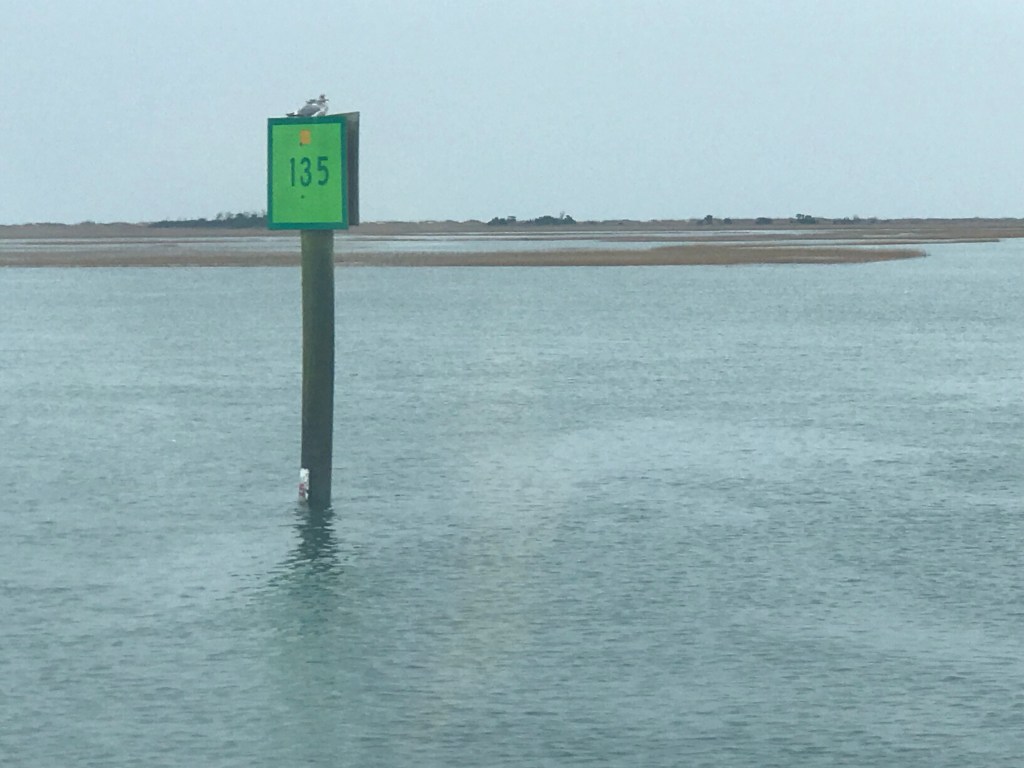
The currents can be seen pulling this green can under as we were exiting Beaufort and rounding the Southern point of Radio Island.
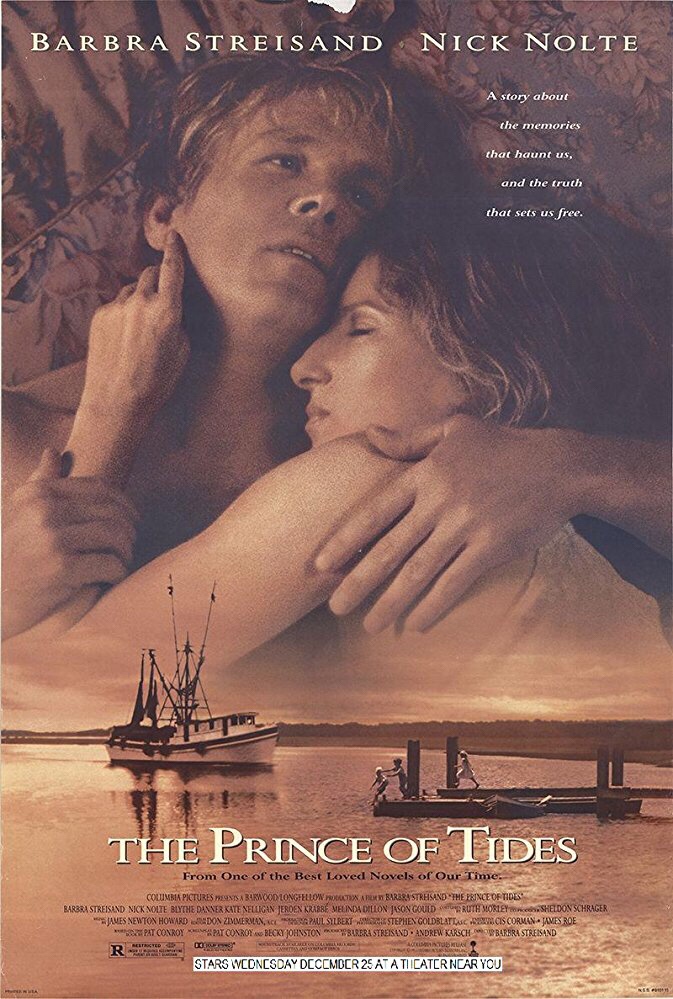
Currents are brought on by the tides and our friend Rebecca informed us the the movie “Prince of Tides” was filmed on location here in Beaufort. Knowing now that the movie was fillmed in Beaufort, maybe it’ll make a good first-time watch while on anchor?
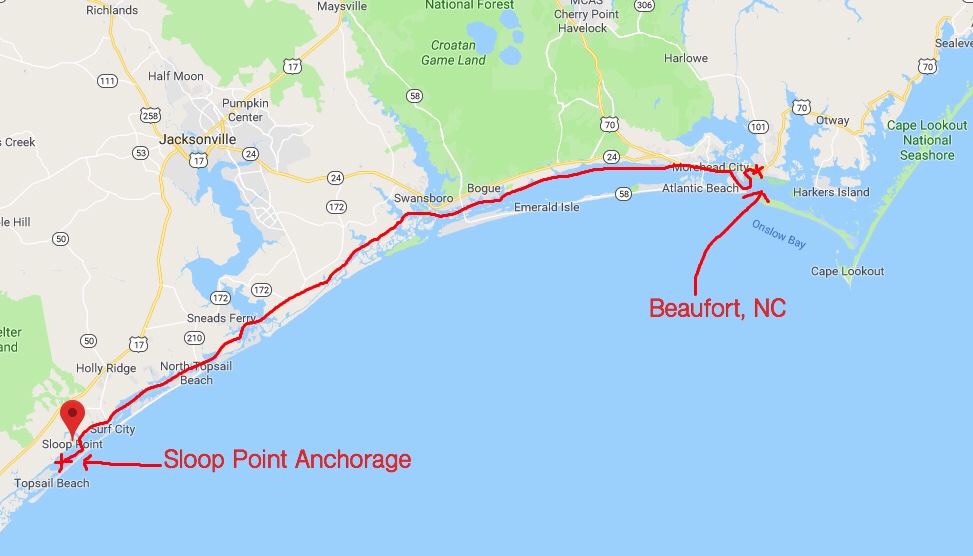
Our last night in Beaufort was a late one and the morning’s light was unwelcomed. We had a long trip ahead of us if we were to make Sloop Point anchorage by sunset.
We needed to make up time so we used the fast currents to our advantage and raced westward through Bouge Sound.
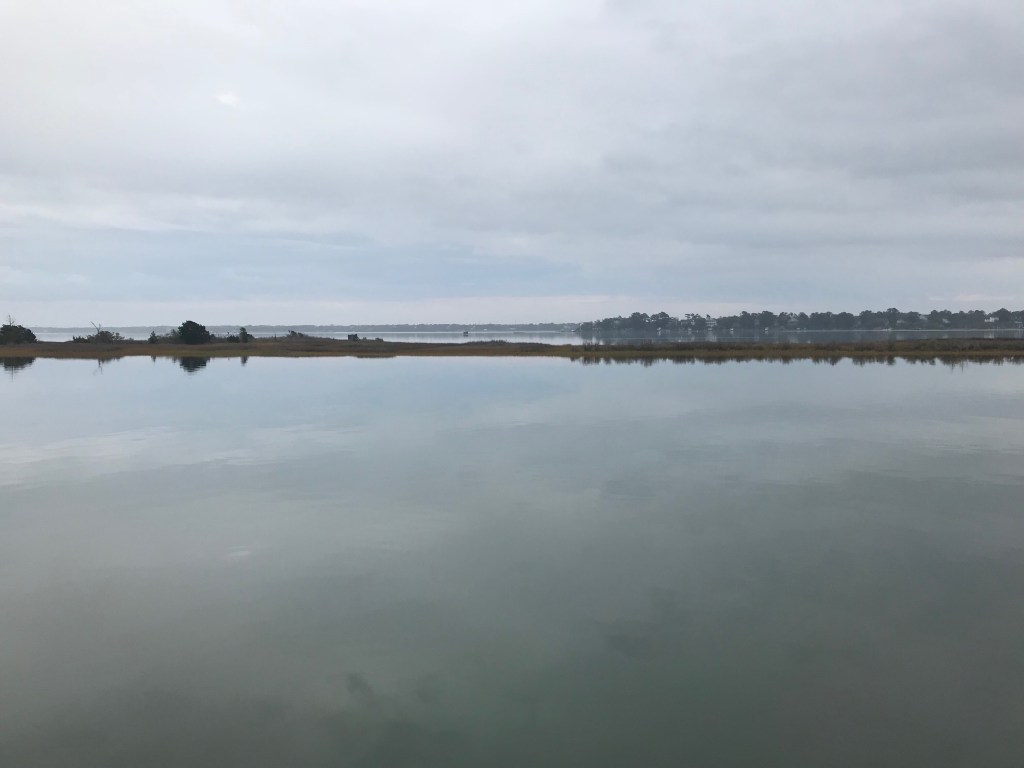
Bouge Sound is an East-West body of water trapped between main land North Carolina and a set of barrier islands. The sound has a narrow channel and marshy islands that abound. While the ocean was lumpy, Bouge Sound was a flat and reflective, like a mirror.
The only boat traffic we passed was a tiny little tug and barge with a piece of heavy equipment on it as well as one of those awkward looking front-loaded boats where you drive from the bow.
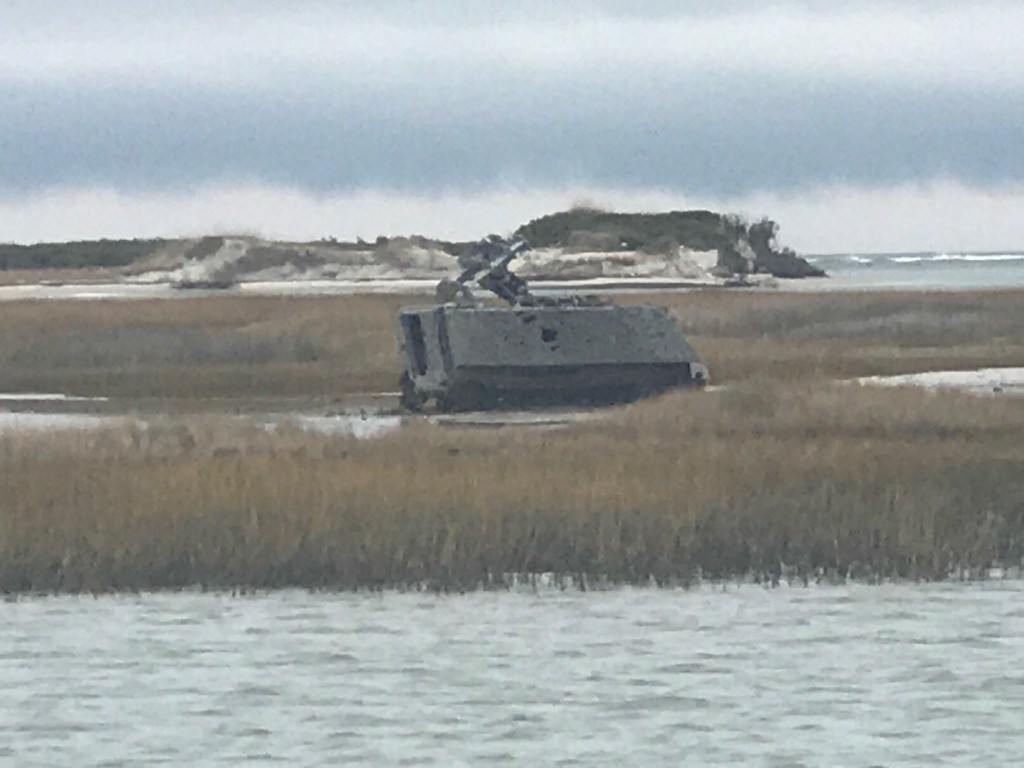
A little further South and we were reminded that Camp Legune is around us. Signs along the river warn of possible live fire events.
This picture of a shelled APC (I’m just guessing this was an armored personnel carrier, military expertise needed here) reminds me of a Monet or maybe a watercolor painting. The marshy grasses in the foreground simply mush together while the island and threatening clouds in the background appear to bleed and wash out the watercolors on a canvas.
With sunset approaching we had to race to make it through the restricted Onslow Beach swing bridge.
Every morning we research where the shoals are along the ICW. It seems the ICW’s bottom is in a constant state of evolution. You need to use sites like activecaptain.com/livemap/ to be able to use the knowledge other ICW boaters have posted to avoid running aground like this poor sailboat did.
We anchored in Sloop Point behind green daymark 15 and it was a peaceful night as we listed to the rain pitter-patter on the boat. The perfect background noise as we whisked off to the master stateroom.
Yesterday morning we awoke before sunrise and got underway to Beaufort, NC.
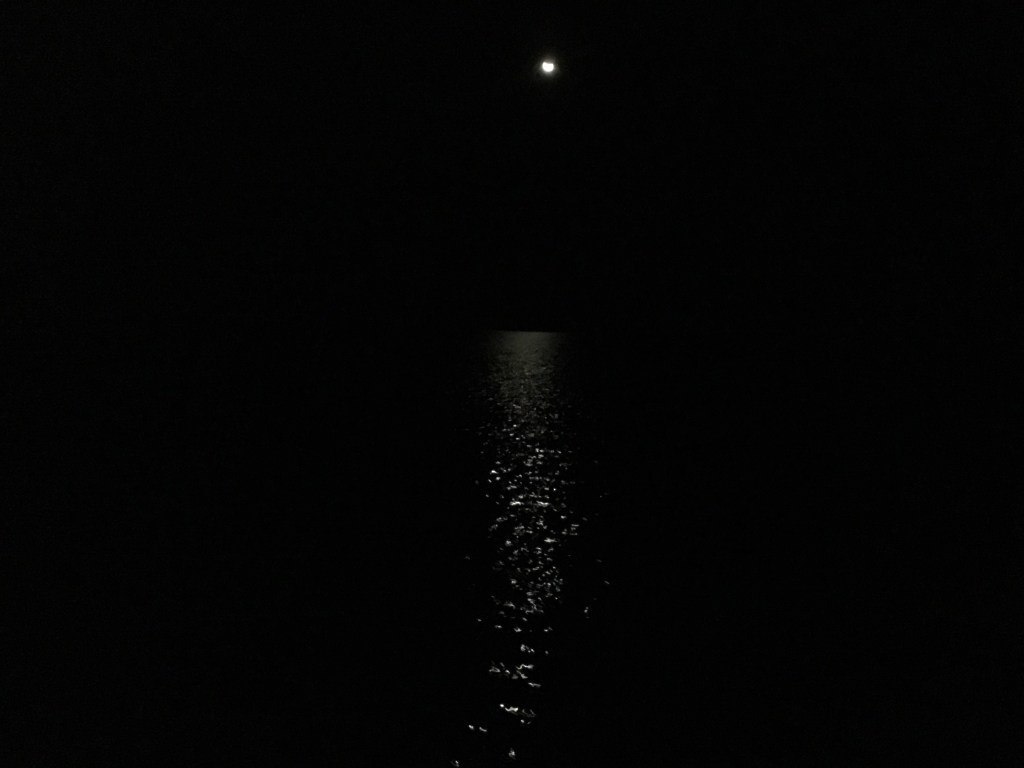
The first & last supermoon of 2017 was helping slice through the dark as we pushed away from the dock.
Supermoon Reflecting the Sun’s Rays
Supermooninfographic
Supermoons happen when a full moon approximately coincides with the moon’s perigee, or a point in its orbit at which it is closest to Earth. This makes the moon appear up to 14 percent larger and 30 percent brighter than usual.
December’s supermoon is actually the first of three back-to-back supermoon full moons to come in the next two months. On Jan. 1 and Jan. 31, the full moon will also occur near the moon’s arrival at perigee, according to NASA, which billed the line up as a supermoon trilogy. The Jan. 31 supermoon is also the second full moon of January, making it a Blue Moon, and also occurs during a total lunar eclipse.
As the sun got ready to sneak over the horizon there was a beautiful orange-pink hue reflecting off the water.
Before Sunrise
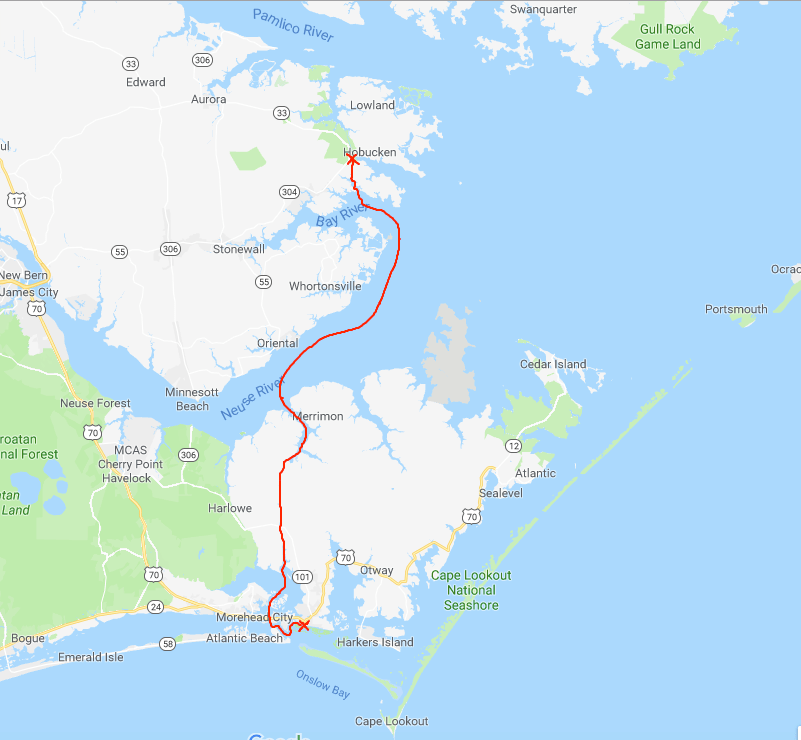
Today’s leg of our journey takes us from Hobucken, NC to Beaufort, NC
The Beaufort of coastal North Carolina is “BOH-fert”. The Beaufort of South Carolina is pronounced “BYOO-fert”. Established in 1709, Beaufort is the third-oldest town in North Carolina.
Beaufort Leg of Journey
As we made our way out of Goose Creek and into Pamlico Sound, the only traffic we passed was a tug pushing a barge.
YATPB – Yet Another Tug Pushing Barge
The dominant wave set was coming from the NE and that meant we had a following sea as we turned and made our way down the Neuse River. A following sea that is slightly to one side of the stern can be annoying when you are at the helm. The waves catch up to the boat from behind and lift the stern pushing it to port or starboard. This can swing the bow as much as 30 degrees at times and it starts to feel like you are pointing the boat all over the place. I made a quick adjustment to increase the autopilot’s response rate and the bow heading deflection lessened considerably. Being a slow boat (6-9 knots) you are often at the helm from sun-up to sundown to make your destination. Autopilot is an electronic device with some firmware loaded on it that drives a hydraulic pump which turns the rudder. There are many settings that you can control but the response rate is the one you will want to adjust so that the rudder position changes are swift or slow enough for how you want the boat to point.
Autopilot Control
Autopilot Display
As weekend boaters, we were boating in destinations like Block Island, Nantucket or Provincetown. These locations are anywhere between 6-12 hours from our home port in Warwick, RI. We would be forced to run the boat at 8.5 knots and only get about 1 MPG. Now that we are full-time boaters, we slow the boat to about 6 knots and get 4 MPG. You can go 4X farther if you simply reduce your speed by 2.5 knots. (Recall 1 knot = 1.15 MPH so approximately every 6 knots you would simply add 1 to get the speed in MPH).
Even knowing this, we made the decision to up the speed to 8.5 knots and reduce the amount of time spent in the following sea.
Happy and Chief Martin Brody appreciated that we burned a a bit more fuel for their comfort.
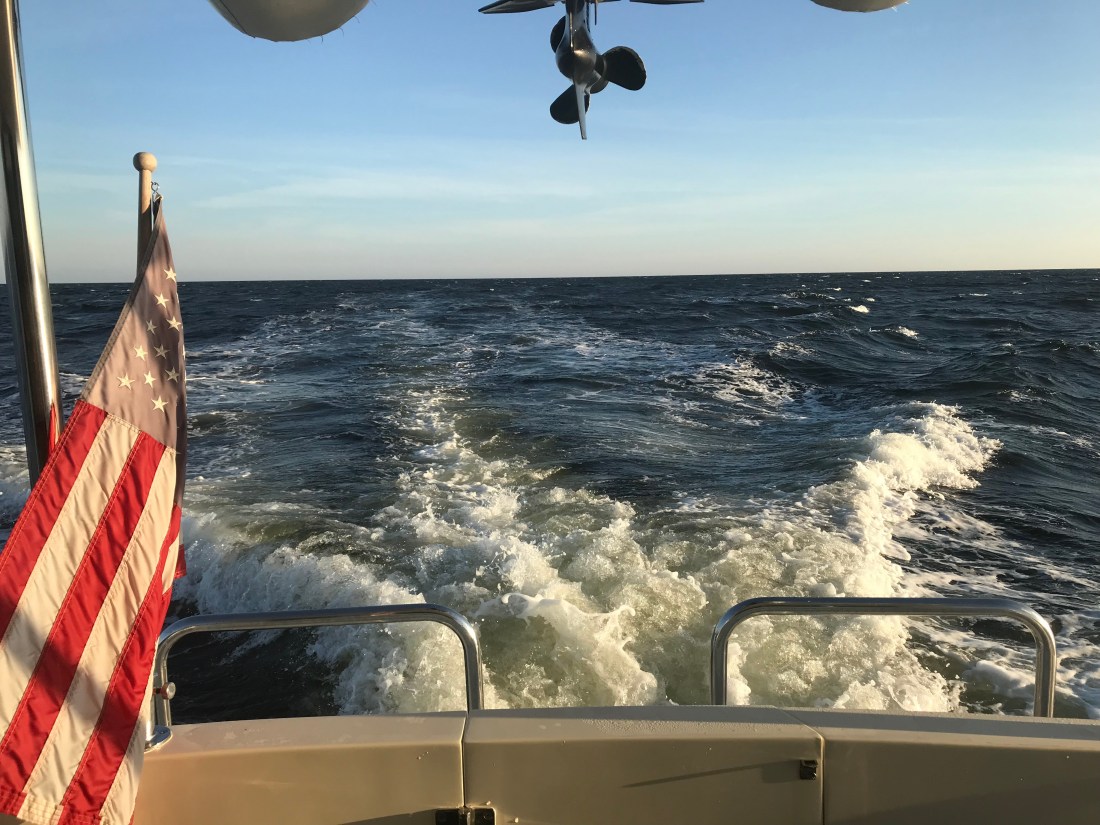
Chief Martin Brody and his Big Sister HappyWake in the Neuse River
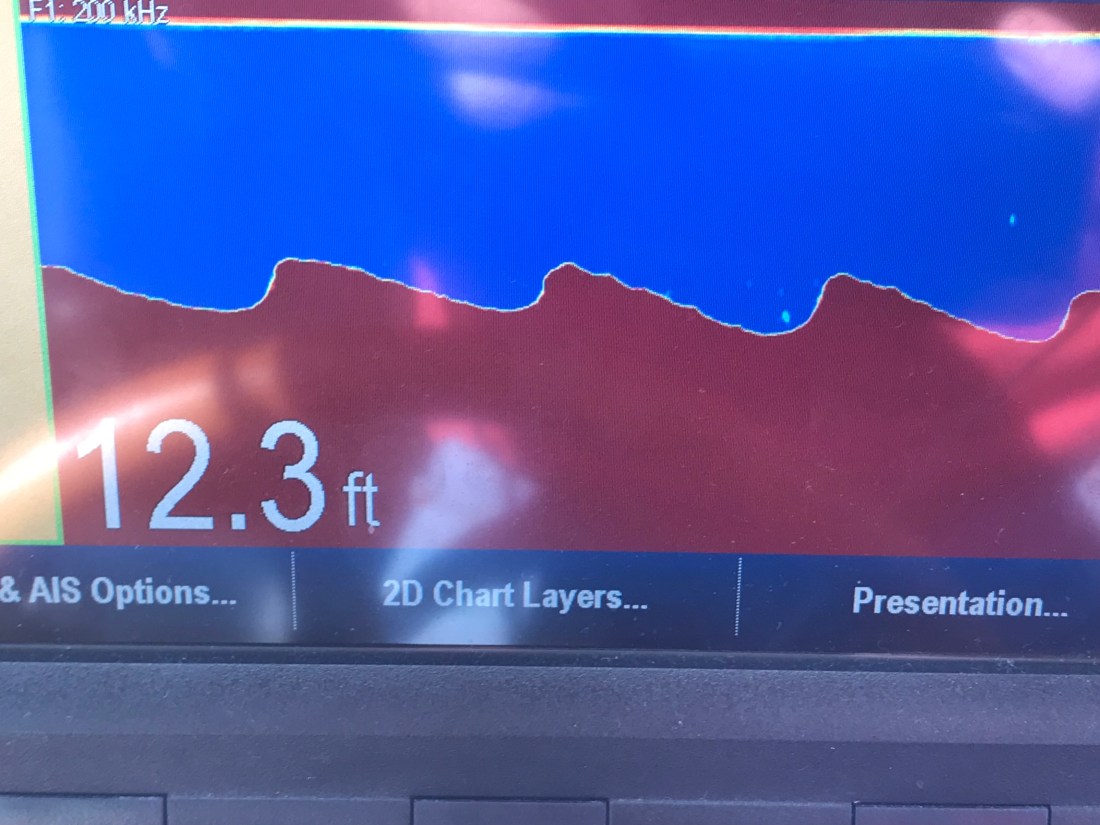
As we turned into Adam’s Creek the ride smoothed out and we dropped back down to 6 knots. The current in Adam’s Creek was swift and the DSM (Depth Sounder Module aka. Fish Finder) was showing asymmetric rippling of the creek bottom. I believe this is caused by a swift bottom current.
Asymmetric Rippled Bottom of Adams Creek
The fish finder was also well, finding fish. The DSM uses sonar or high frequency sound generated by a device that protrudes through the hull and is sending a column of sound waves straight down beneath the boat. These sound waves not only reflect off the bottom but when they hit a fish the sound resonates in the fish’s swim bladder (a small air-filled sack that helps control a fish’s buoyancy) and this echo is detected and colored sharply to allow you to spot fish on the screen.
Look Swim Bladders
Adam’s Creek is a lovely place with lots of sights to see.
Bonus Points for Parking Your Helicopter in Front of Your Mobile Home
Boat Slip only $75K
I’m Pretty Sure The War Over Slavery Ended?
Adams Creek spills out into the Newport River and it’s marshes and shallows are something that you will want to avoid.
Newport Marshes as you Head South to BeaufortKelly & I Often Joke… “If You Want to Know Where it’s Shallow; it’s Where the Birds are Standing”
As we pulled into our slip in Beaufort we hailed the dockmaster who warned us about the swift current running transverse to the slip we were assigned. As we pulled in to the fairway the current slammed into our full keel and began to push the boat toward the bows of the boats across the fairway. I was forced to back out quickly and reposition so that I could now take the swift current into account and position the boat for rapid spin and quick back into our slip. Kelly was quick to toss lines to the dockhands and soon we were checked in and given the keys to a “courtesy car”. Up North, I’ve never stayed at a marina that offers a fee courtesy car to marina guests. The car was a welcome treat and we put it to good use re-provisioning the boat with more food & beer.
Courtesy Car – We Got Wheels!
With all our chores completed we quickly made off to the marina bar for happy hour and spent time chatting with Bartender Kristen and fellow bar patron, Dan. Dan was an amazing fellow who told us stories of his solo sailing around the world in a small boat. He offered us some local knowledge about wild horses that roam the islands around here. I KNOW more wild horses to find!
Kelly & Sailor Dan
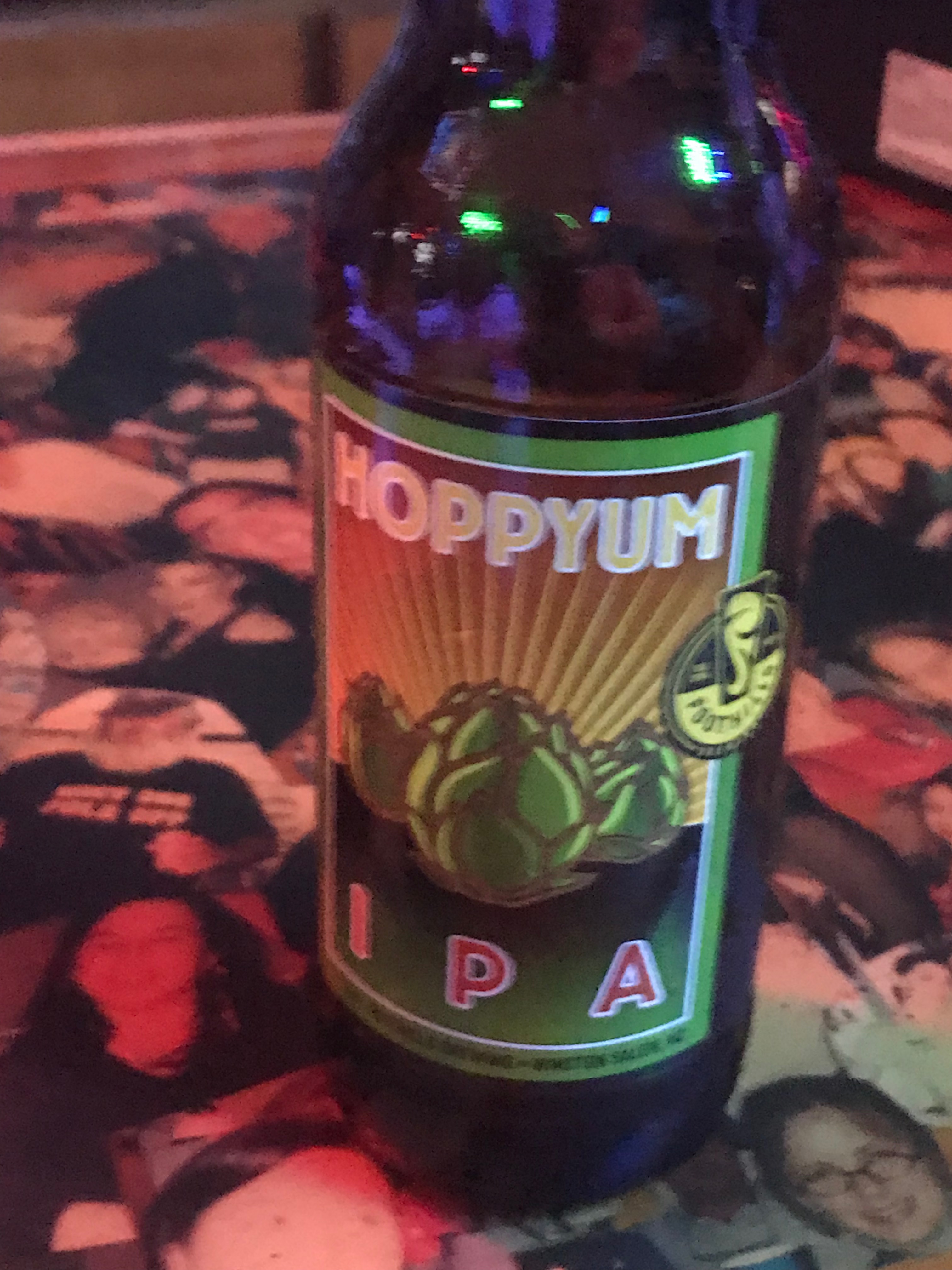
After I consumed as many 50 cent pork sandwiches as a man can eat and washed them down with a great local IPA it was time to retire to the boat.
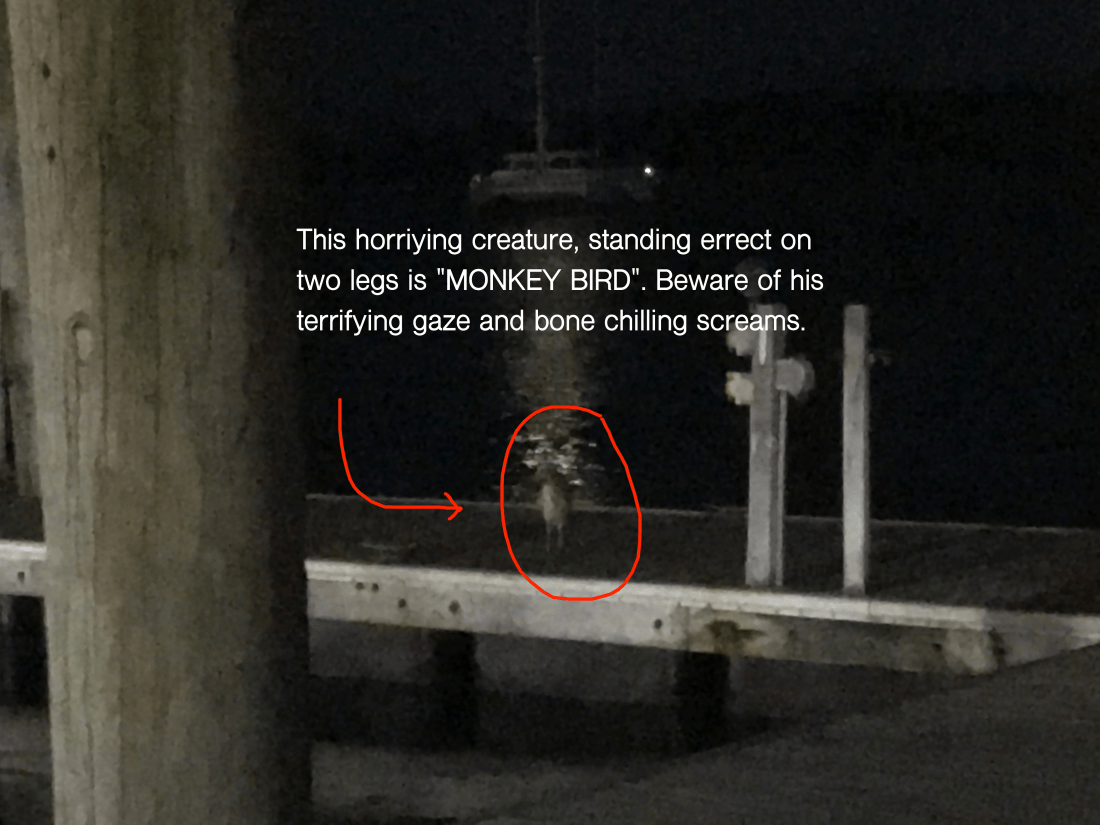
We were no sooner readying for bed when we were accosted by “Monkey Bird”. This vile creature had a penetrating stare and an awful cry. I spent sometime staring into this monster’s gaze and knew it was time to lock the door and keep the crew of Simple Life safe.
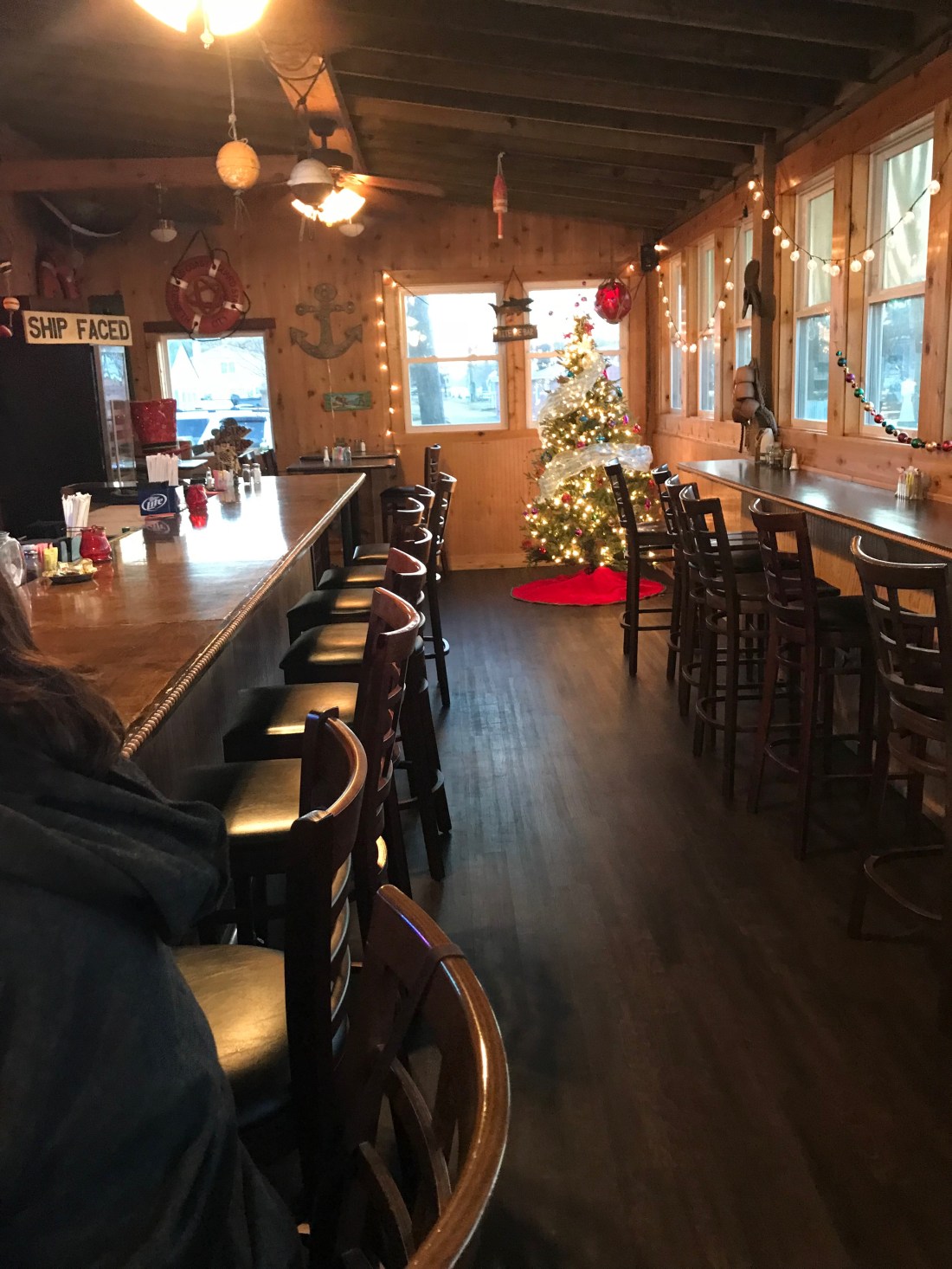
Coinjock Marina is a great place to stop along the ICW. The Sandbar even had an Xmas tree up.
Too Early?
While we were at the pier a 1998 Bayliner 4788 arrived during the night and as they passed us we saw the severe damage to their bow.
Hope Nobody was Injured
It was a reminder about how dangerous boating down the ICW can be (especially when traveling at night). I hope nobody was seriously hurt. After having a crash like that you’d think you’d stay far away from everyone but as they passed us I thought for a second that they might hit us.
Yikes – This Pic Snapped Out My Pilothouse Window!
At that moment I went out in my PJs and attached two fenders to the canal side (just in case 😉 )
When we left Coinjock Marina it was foggy.
Coinjock Pier Looking Off our Stern
Even as we headed down the canal we had to rely on our radar to see any far out vessels.
Fog Was Worse Than This at Times
As you travel down these canals you will find homes along the canal and people going about their daily business.
Me Waving from the Pilothouse to the Locals
As we traveled along we saw several boats anchored just outside the channel. Being anchored well after sunrise is a sign that someone is having a peaceful morning enjoying their coffee.
Peaceful Morning on Anchor
We continued South down the North River and into Albemarle Sound. There was not a single boat to be found in the sound. We had the crossing to ourselves. While approaching the mouth of Alligator River I saw, what I thought were boats but upon closer binocular examination, I see they are some sort of mini islands? I’m not sure of their purpose? They look to big to be duck blinds?
I Need to Figure Out What These Are?
We anchored at the head of the Alligator River as we lost daylight. The anchorage was quiet with no boats passing but the cellular signal was dead. During much of the transit we would see our cell signal go from LTE => 3G => Extended 1X => blank. At times we would be excited to see 3G and upon trying to connect, we’d see the signal instantly drop to “Extended 1X” which did not work at all.
What Kind of Tomfoolery is this?
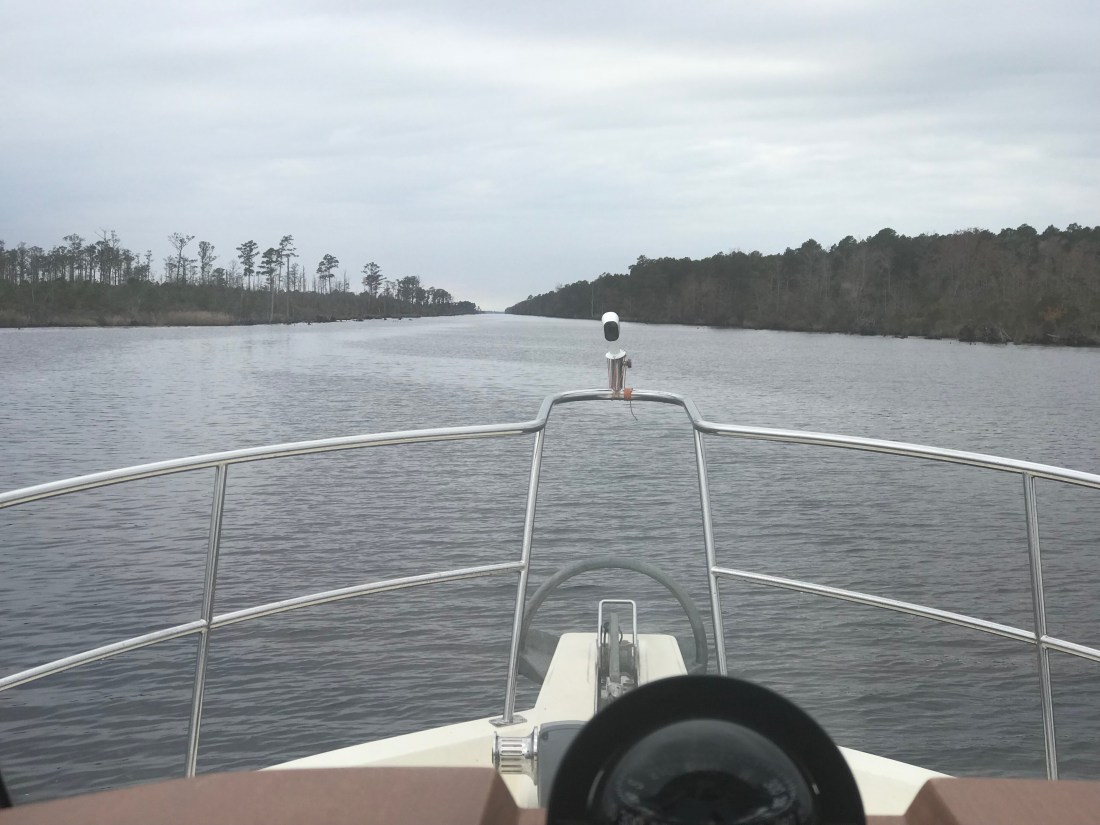
The Alligator River – Pungo River Canal was long and straight.
I Can See For Miles
Along the banks of this canal you can see the erosion from passing wakes.
Geology Experts of the Future Will be Doing Molecular Analysis on That Green Line
You will see many birds as you float along. It’s a reminder to me to improve my ornithological skills.
Where are my Ornithology experts?
Where is His Beak?
You’ll see other things that you’ll want to stay clear of like …
Fishing Nets
Sticks = Hazard
Are We Too Heavy for This Dock?
At times this can be difficult as you run straight down the sun heading South. While the camera does well looking into the sun, I was struggling at times.
Staring Match With The Sun
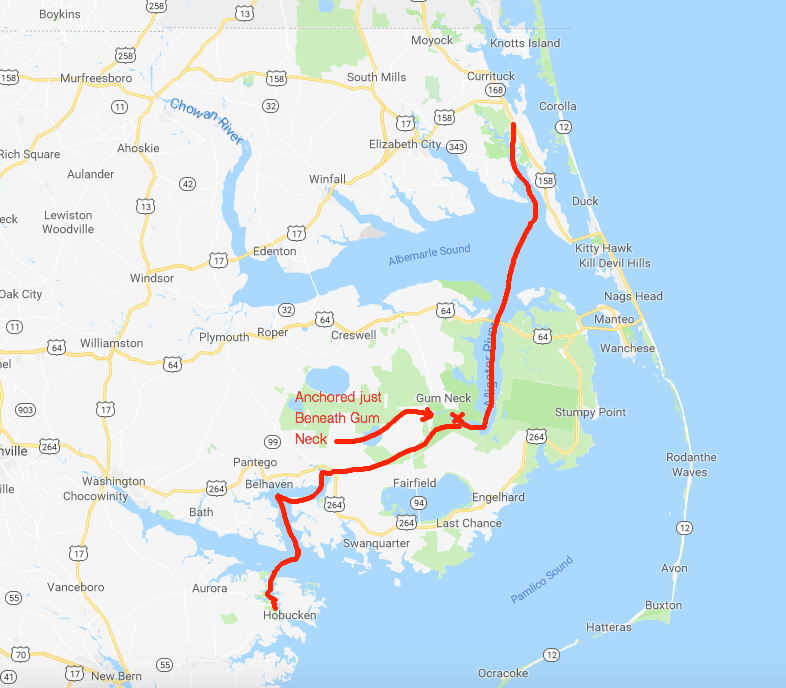
We arrived in Hobucken, NC and tied to an old dock for the night.
2 Days Journey
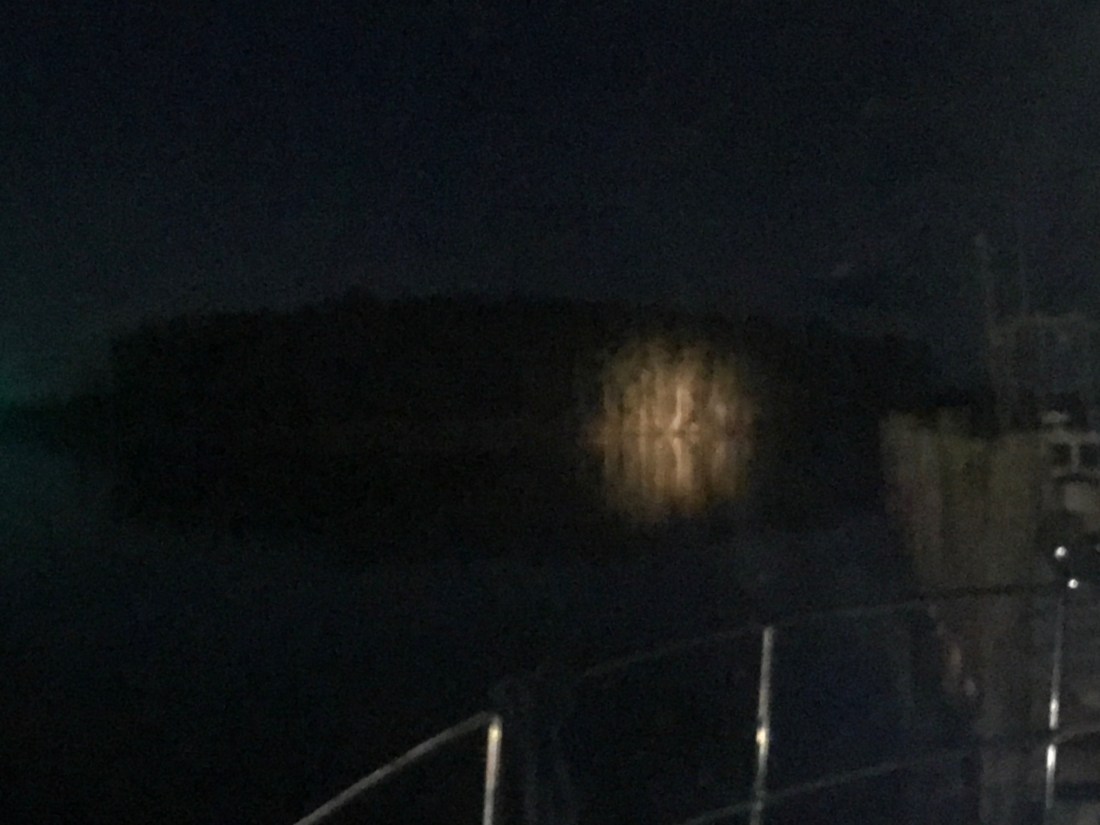
It’s been quiet here except for the passing tug pushing a barge down the river at night. At one point I was staring at a stand of tall trees that were illuminated on the shore and I could not for the life of me see the source of that light?
A Stand of Trees Illuminated
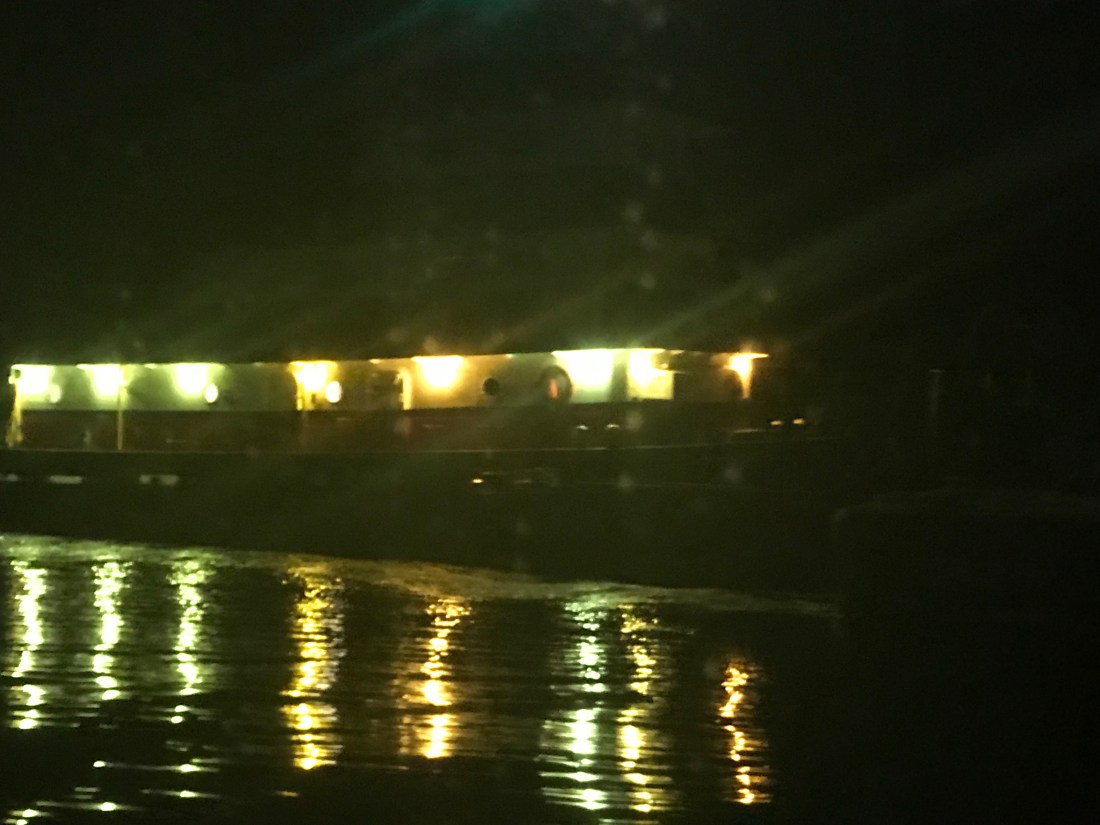
It became apparent moments later that it was the spotlight of an approaching tug and we braced for it’s passing wake.
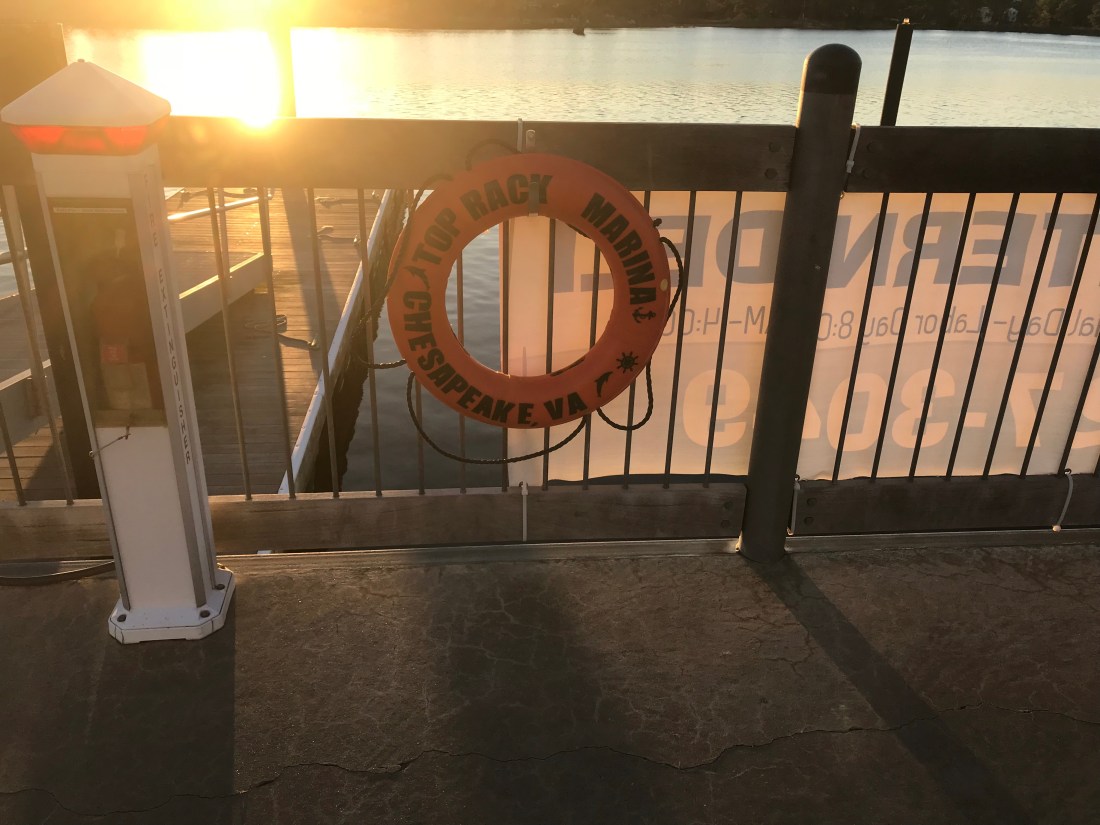
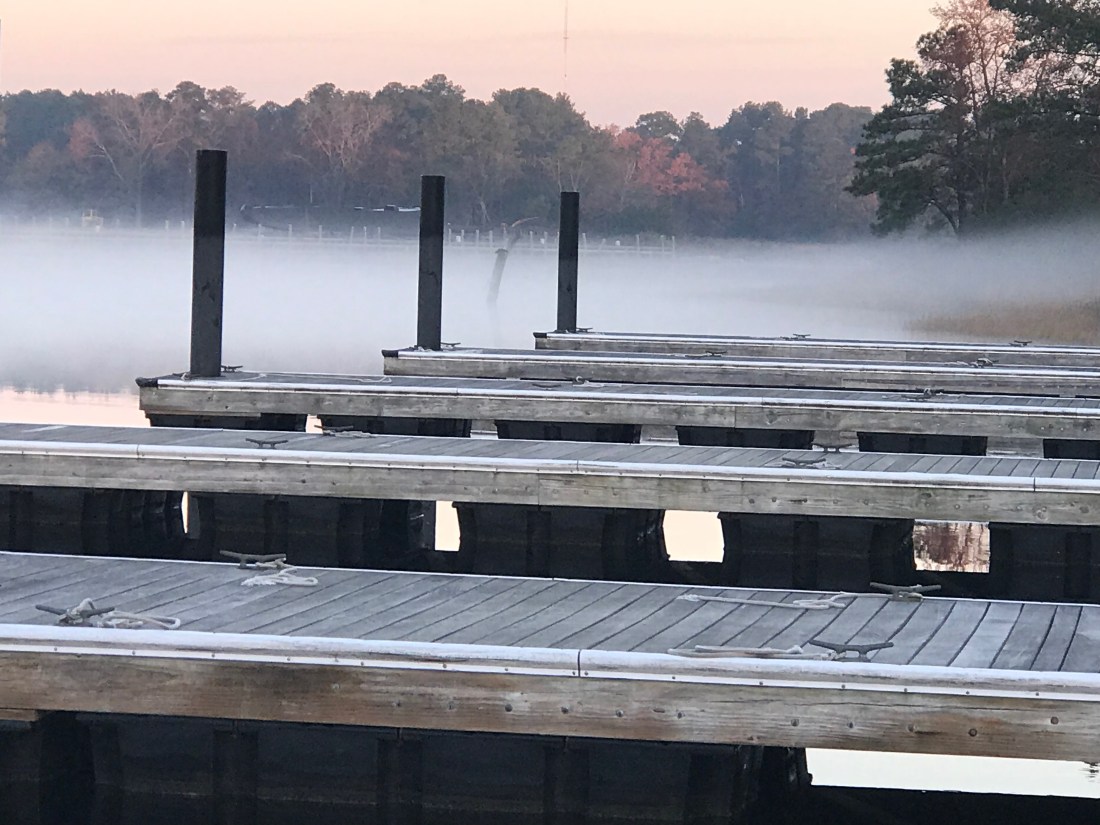
We spent two nights at the Top Rack Marina (ICW Statute Mile 8.8) in Chesapeake, VA.
Top Rack Marina – a nice stop along the ICW
What a great place to stop. When we arrived at the marina, Ben was there to catch our lines and greet us with a some Virginian southern hospitality. Top Rack Marina is a “dry rack storage” marina. These style of marinas store their customer’s boats on indoor racks rather than floating in a traditional “wet slip”. Customers simply call and request their boat dropped into one of the dozen or so wet slips in the marina’s water edge.
Kelly relaxing in the cockpitIndoor racks hold boats like a grocery store shelfOutdoor racks act as staging locations as boats are washed, flushed and prepped
Their giant fork truck moves boats effortlessly and can be intimidating as it whirls around with a boat high in the air.
We decided to stay for two nights and re-provision the boat. Usually we would have to grab a Uber to a nearby grocery store but we have found that grocery delivery services are a much faster, cheaper and a far simpler way to restock. When we were in Brick, NJ we used Peapod from Stop & Shop but here in Chesapeake, VA we used Farm Fresh Supermarket.
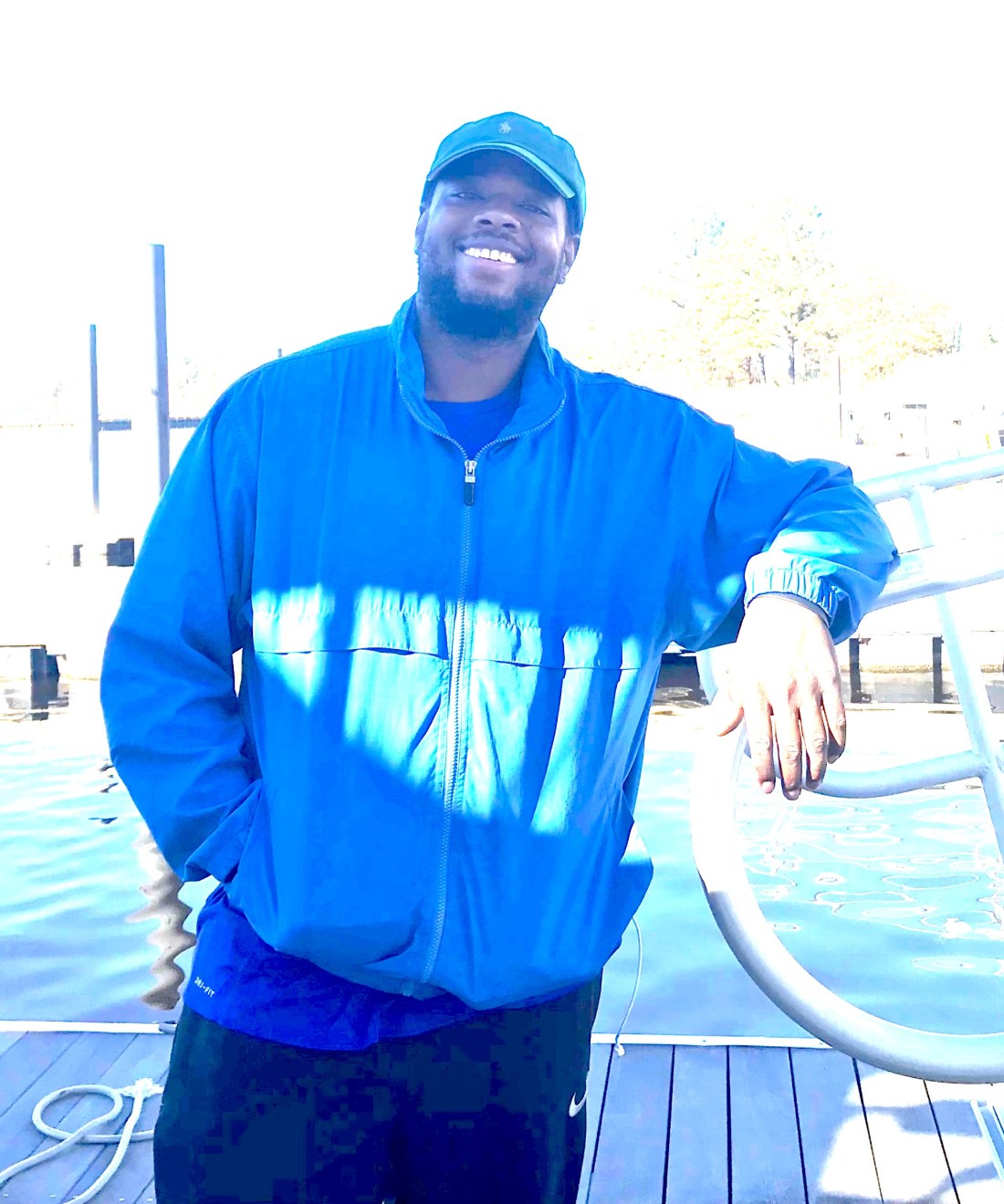
Jaquay was our designated shopper and he would text us with pics of substitutions for any out of stock items on our list. Jaquay picked our order, drove dockside and was kind enough to help carry our groceries aboard. Thanks Jaquay.
Jaquay
The marina has a great ship store and Deli and as I checked in with Brian at the front desk, Brittany was there to help me select a local IPA beer called “El Guapo IPA”. El Guapo is brewed locally in Norfolk, VA by O’Connor Brewery
In Spanish El Guapo is a beautiful guy, a well looking male
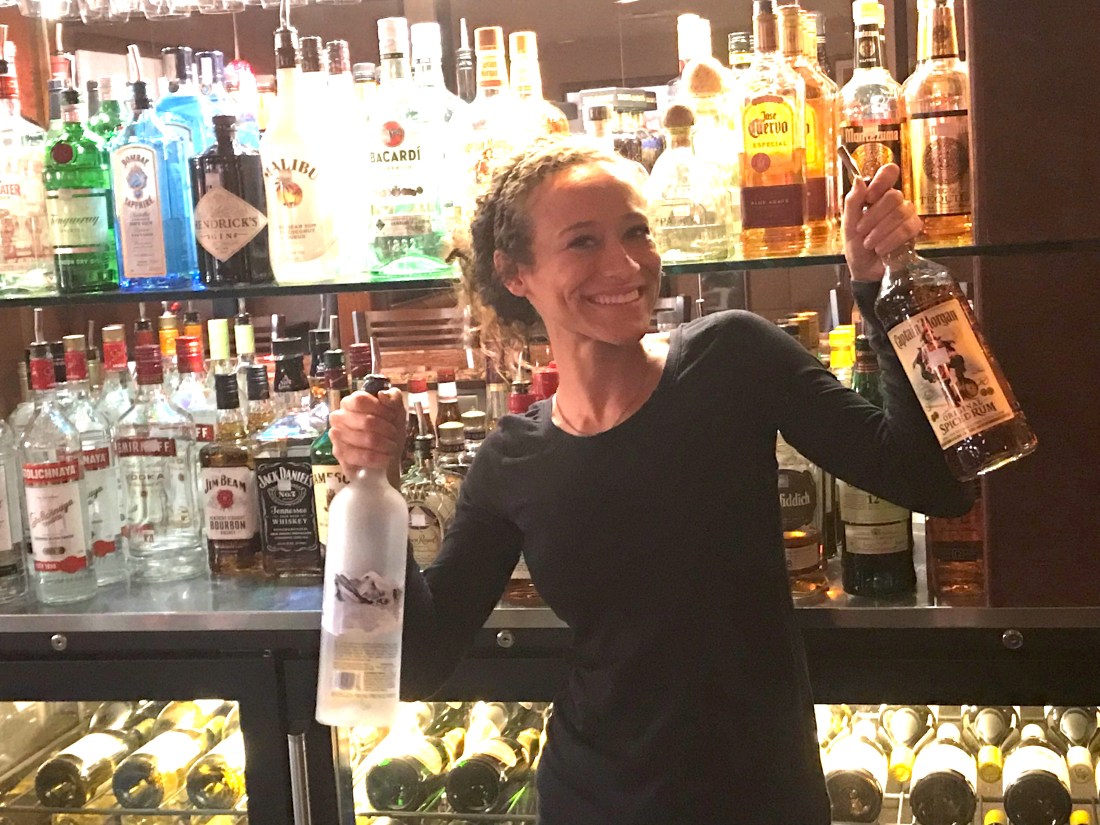
Then it was on to dine at the Amber Lantern Restaurant. We stepped out of the elevator and hostess Courtney warmly greeted us. We got an early start at the docks and by the time the restaurant opened at 4PM, we simply poured ourselves into seats at the bar. Bartender Sydney kept us smiling the whole night.
Sydney’s smile could warm the heart of even the crustiest sailorDynamic Duo: Sydney and Courtney
Being first into the restaurant, we had the chef to ourselves and the food was amazing. We had our fill and retired back to the boat only to wake up at the witching hour of 3AM and sing along with YouTube videos from artists in the “Forever 27 Club”. I recall some Janis Joplin was echoing out over the river… “Freedom’s just another word for nothing left to lose”…
We awoke to a ghostly fog creeping down the river and we quickly shoved off to race and catch the Great Bridge Lock opening at half-past-every-hour.
ICW fog
Once at the Lock we tied up to the Southern wall, waited for the lock doors to silently close and watched as it lowered us gently down to the height of the water on the Albemarle Sound side of the lock. I find it interesting that while the Elizabeth River side of the lock is tidal and varies about 2.7 feet the Albemarle Sound side varies only due to the winds that drive water up or out of the river. Equally as amazing is the age of the machinery that drives these locks. You watch as giant gates and machinery, built using simple principles of engineering mastered many years ago, silently close.
We kept the ICW-bridge-list.pdf displayed on the iPad we’d have the requisite knowledge at our fingertips. As you pilot the ICW you will want to be aware of such things as… What bridges are around the bend? Can you safely pass under their vertical height? Are they restricted in opening times? How to contact the bridge tender on to request an opening?
ICW bridge list for all 1,243-miles of ‘inland’ waterway
As you make your way down the Albemarle Chesapeake Canal you can’t help but notice it’s as straight as spaghetti. The Canal was originally conceived of in 1772 but had to wait until technology advances (circa 1856) that allowed steam-powered mechanical dredges to cut through the land. While the canal is over 70 miles long, there is only 14 miles of excavated land. There are really two different “cuts”. The 8.5 mile long Virginia Cut which connects the Elizabeth River with the North Landing River in Virginia and the North Carolina Cut which is 5 miles long and slices across the Currituck Peninsula at the village of Coinjock to enter the North River, flowing south into the Albemarle Sound.
Historic chart denoting the Virginia and NC cuts
This canal is a wonderful part of American history. During the U.S. Civil War, when the Union Army commandeered the canal, nearly 9,000 vessels made the transit. After the War, traffic continued to increase as the waterway took over practically all of the trade passing between the Albemarle Sound and Norfolk, Virginia.
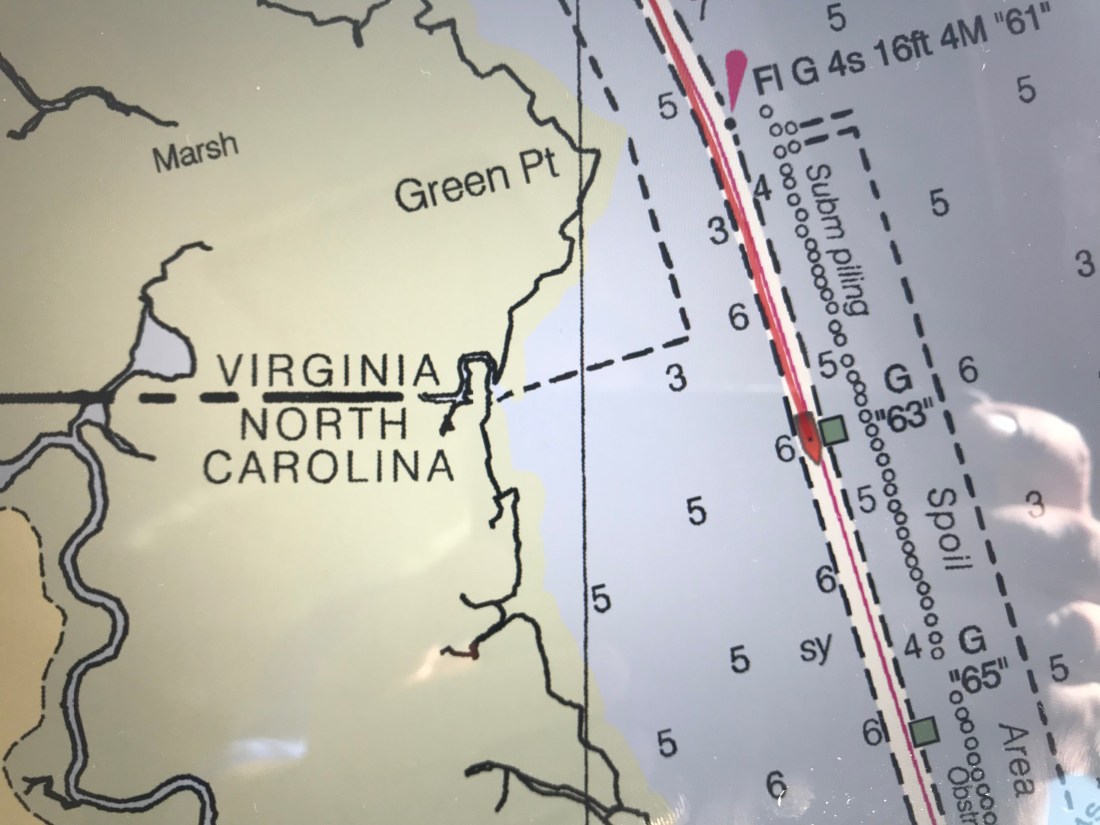
As we meander down the ICW at a leisurely pace of 6 knots (4.5 MPG) we noted the passing from Virginia into NC. Then just a short while later, we were stumped to explain why this looping side canal was littered with wrecks? How did this happen?
VA / NC State Line – ICW statute mile marker 34How did this happen?Gently used boat for saleMaybe this cannon we passed was responsible for the wrecks 😉
The scenery at this point in the ICW is amazing! The waterway is lined with tall grass and you’ll watch as the local duck hunters race by you in camouflaged flat bottom boats. We’d pass the occasional duck blind hidden in the grass and Kelly & I would jabber about the moral issues of tricking ducks with decoys into becoming dinner. I’m always intrigued by the human race’s dilemma between a desire to coexist peacefully with all the other animals on planet Earth and our need for subsistence.
We soon arrived at Coinjock Marina where dock hand, JD quickly moored us to the wall and we scurried off to the Sand Bar for an IPA, some buffalo wings and a filet mignon for Kelly.
A typical sailor bar along the ICWThe restaurant is known for their amazing prime rib
Inside the bar we met Bartender Jason and shared stories with other cruisers going South down the ICW. The three captains of a brand new 45′ Hatteras sport fishing boat that was making its way South sat next to us. They showed us video of their 30 knot trip South and we joked about their 80+ g/hr burn rate vs. our 1.2 g/hr rate. “Time is money” said one of the captains as they hurried out of the bar joking that they would not wake us at sunrise as their sprint South continued. Well it’s 6:30AM and we just watched them depart silently. I’m sure today will be another fun time here in Coinjock, NC.

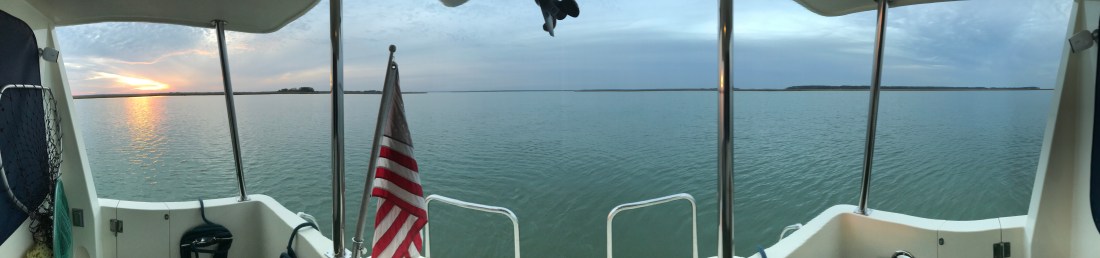

 We awoke around 4 AM and snapped this pic looking off the stern of the boat.








 I’m dying to see one of those live oaks that look like something out of a fairytale down here.







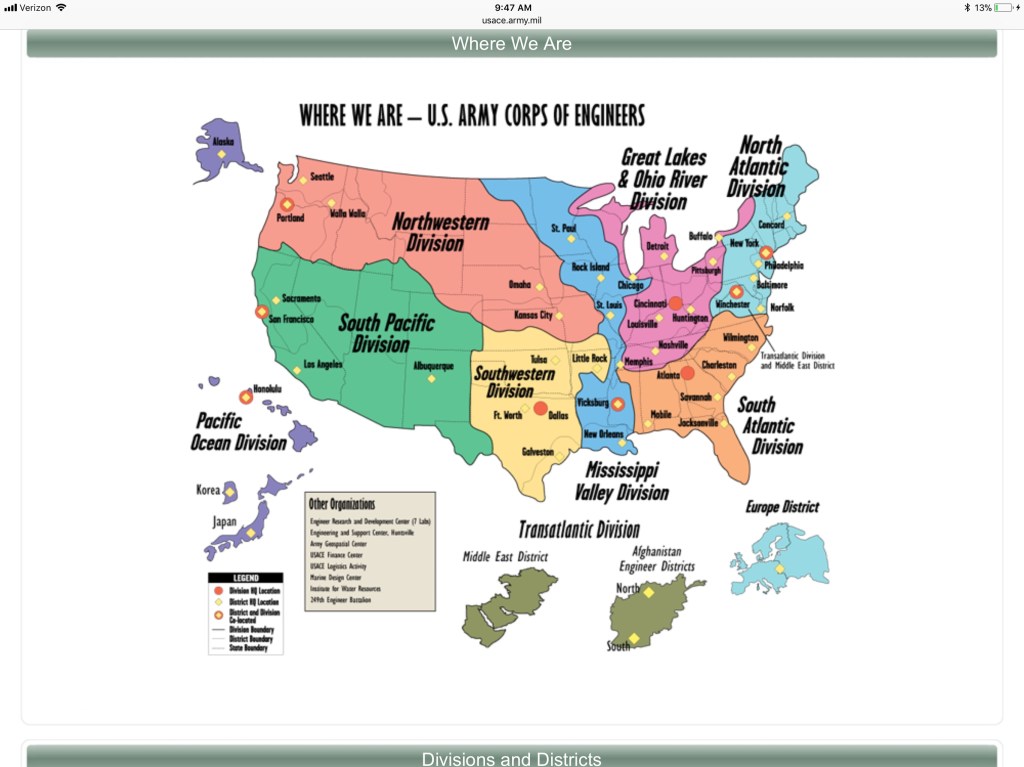 Each Division / District has its own website so you’ll have to spend some time finding the hydrologic maps from each ACE District.
 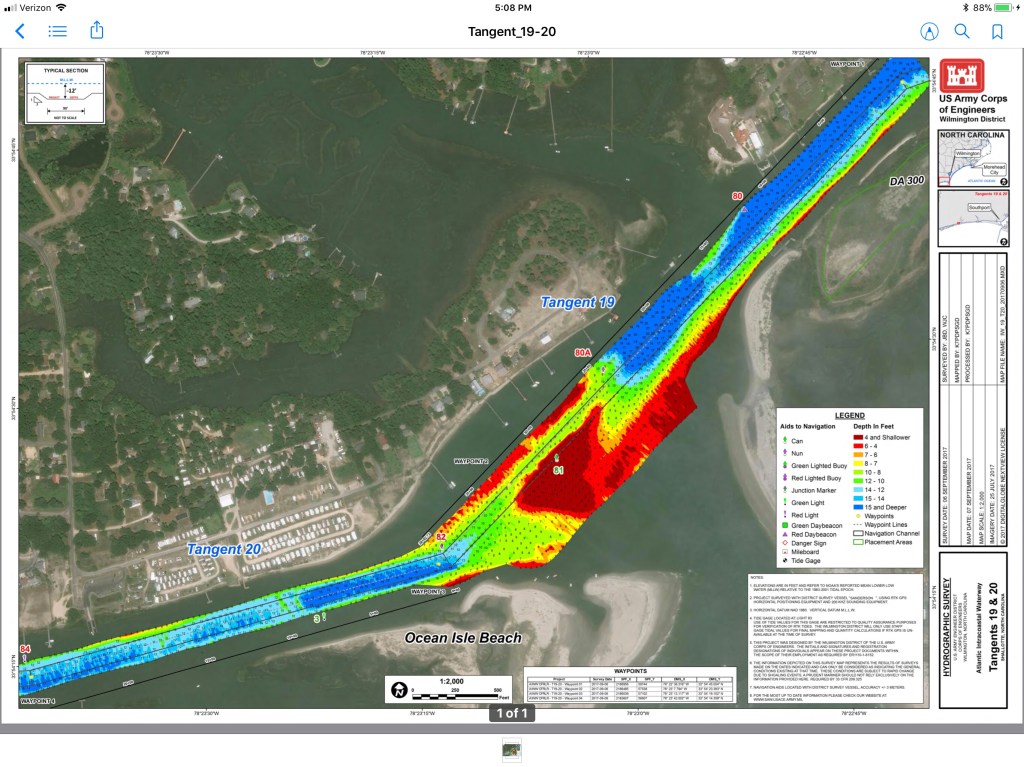 That’s a narrow drugged channel that you must stay inside of
  Stay to Port.
 We have no idea what species of bird this is but we are committed to learning more about the aquatic bird species that inhabit the ICW.


 I think the sign said something like Greg Norman’s Australian grille
 We love that this guy was taking his dog for a ride. Man’s best friend loves the boat says Happy & Chief Martin Brody.
  “Born 200 years too late” – Jimmy Buffett
 Somewhere Myrtle Beach
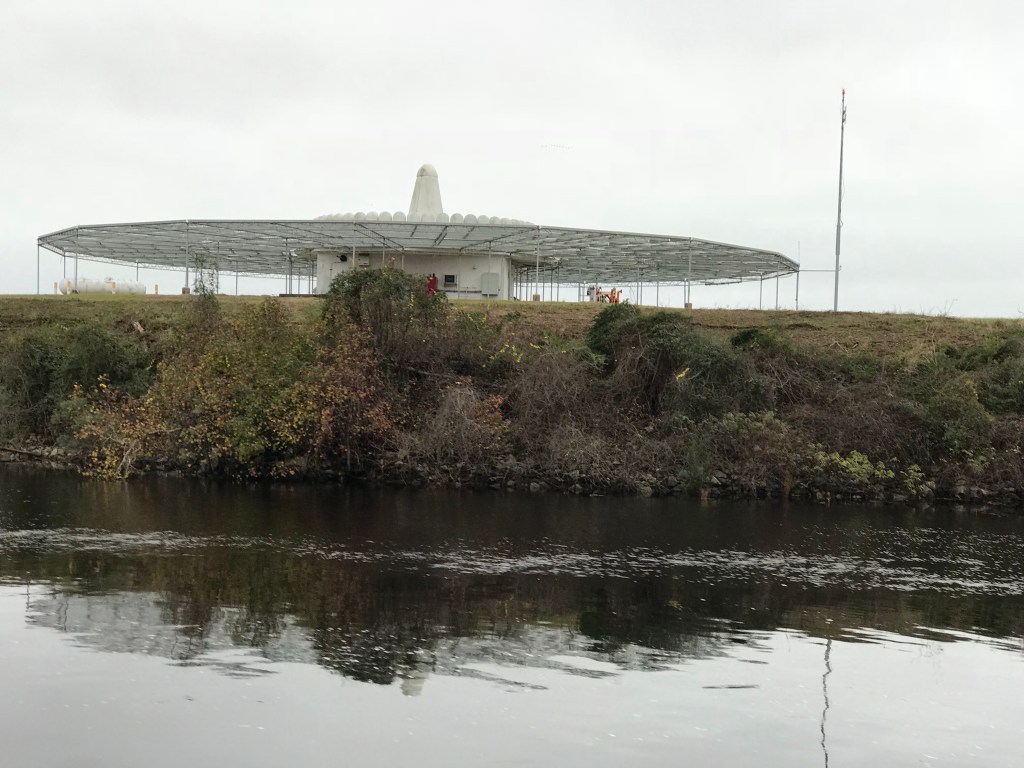 Close Encounters or an airport building, you decide.
 Who wants to walk under this rack with high winds and a 10K lb boat resting 80′ over your head?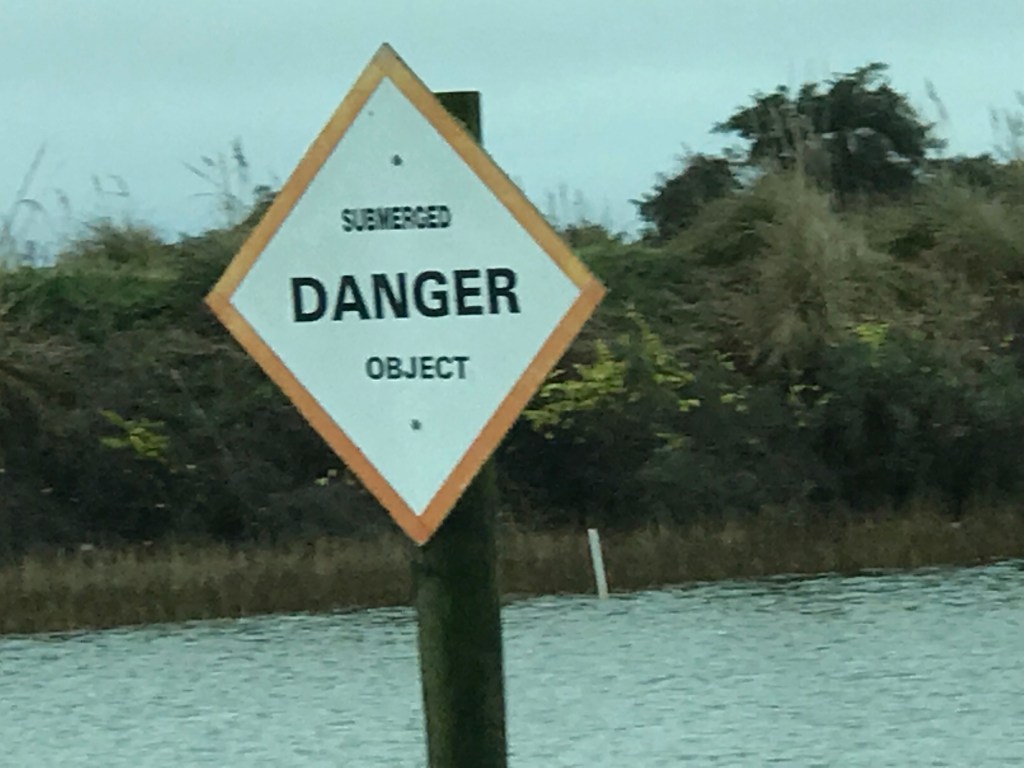
 Logs are the bumps in road of life They thud your hull or fold your wheel (that’s a propeller for the un-initiated)
 We hate to see beautiful commercial fishing boats listing on the bottom. We joke that we’d love to pull her up drain her beige, gut her and rebuild her giving her a sexy teak makeover. Kelly reminds me that the stink of a fishing boat is not washed off with soap.
 Ouch!
Ouch!



































 MV Simple Life
You must be logged in to post a comment.